Project Brief

Binarygrace explored a digital wholesale distribution platform designed to simplify ordering, inventory management and customer account operations for an electrical supplies distributor serving businesses across multiple locations.

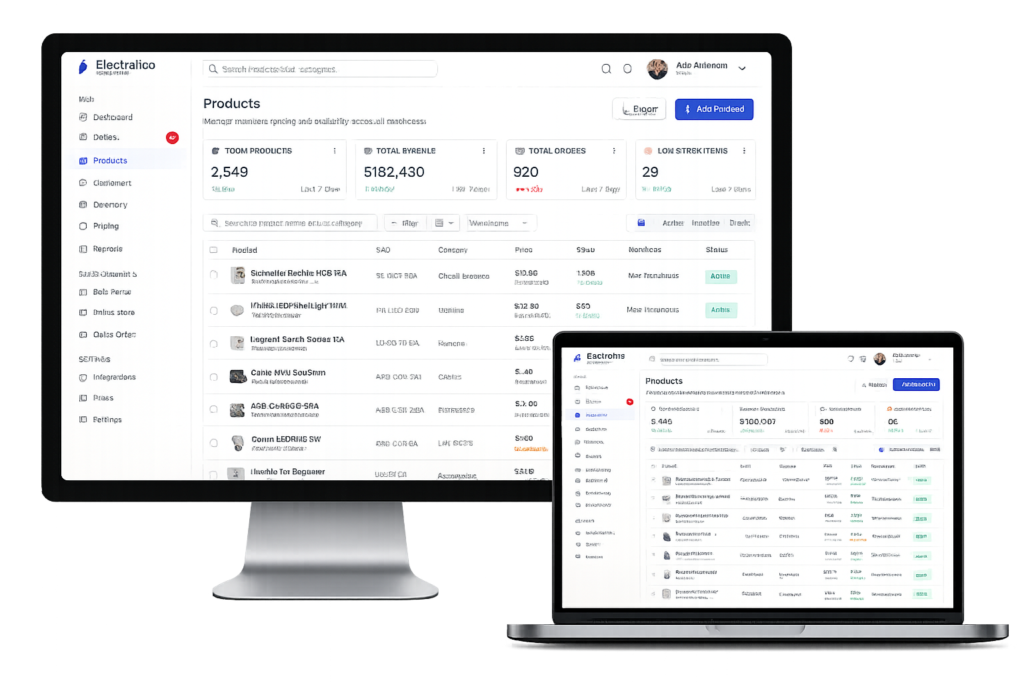
The platform provides registered trade customers with a dedicated online ordering experience where they can browse products, view account specific pricing, check stock availability, place orders and access their previous purchasing history.

The solution connects the customer facing portal with the distributor’s existing inventory and accounting systems, reducing manual order processing and helping the internal sales team manage orders more efficiently.

Challenges

Wholesale electrical distributors often manage large product catalogues, multiple warehouses, trade customer accounts and supplier relationships through disconnected systems and manual workflows.

The key challenges included:

  • Fragmented inventory data: Product availability across multiple warehouses needed to be consolidated into a single view.
  • Complex pricing structures: Different trade customers required individual discounts, negotiated rates and customer group pricing.
  • Manual data synchronization: Product, stock, pricing and customer information needed to be transferred from the existing ERP system without introducing inconsistent records.
  • Order processing inefficiencies: Orders received through phone calls and emails needed to be moved into a centralized digital ordering workflow.
  • Supplier data integration: External supplier catalogues and stock feeds required automated processing and product mapping.
  • Data reliability: Invalid, incomplete or outdated import files could potentially overwrite accurate business data.
  • Operational visibility: Administrators needed clear visibility into synchronization activities, failed imports and order processing status.

Solution

Binarygrace designed an integration driven B2B wholesale ordering platform that connects the customer facing portal with existing ERP and supplier systems through a centralized backend integration layer.

The architecture uses scheduled data ingestion pipelines to process product catalogues, customer accounts, pricing and warehouse inventory from structured CSV/XML feeds and API endpoints.

A dedicated import processing engine validates incoming datasets before updating the production database. Each import undergoes schema validation, mandatory field checks, data type verification, duplicate detection and business rule validation.

For example, product imports are checked for valid SKU references, non-negative prices, required product fields and acceptable record counts. Invalid records are rejected and logged without replacing the last successfully synchronized dataset.

The platform also includes an automated order processing pipeline that captures customer orders, validates account information, applies server side pricing rules and forwards order details to the connected ERP system.

The integration layer was designed to support different ERP connectivity methods, including REST APIs, scheduled file exports and secure file transfers, depending on the capabilities of the existing business software.

Key Features

1. B2B Trade Customer Portal

  • Secure authentication and role based access.
  • Individual trade customer accounts.
  • Customer specific product catalogues and pricing.
  • Product search, filtering and category management.
  • Bulk ordering and quick order functionality.
  • Purchase history and one click reordering.

2. ERP Data Synchronization

  • Automated CSV/XML data ingestion.
  • REST API based integrations.
  • Scheduled synchronization jobs.
  • Product, customer and inventory data mapping.
  • SKU and account number based record matching.
  • Incremental synchronization and change detection.
  • Duplicate record prevention.
  • Data validation before database updates.

3. Import Processing & Validation Engine

  • Automated file structure and header validation.
  • Mandatory field and data type verification.
  • Negative price and invalid quantity detection.
  • Duplicate SKU and customer reference checks.
  • Configurable record count thresholds.
  • Rejected record tracking with error reasons.
  • Transaction safe database updates.
  • Rollback protection to preserve previously imported data.
  • Import execution history and processing statistics.

4. Customer Pricing & Discount Engine

  • Individual customer pricing.
  • Group based discounts.
  • Negotiated trade pricing.
  • Volume based pricing rules.
  • Server side price calculations.
  • Restricted access to trade pricing.
  • Centralized pricing synchronization.

5. Multi Warehouse Inventory Management

  • Consolidated inventory across multiple warehouses.
  • Warehouse specific stock availability.
  • Scheduled stock refreshes.
  • Stock status indicators.
  • Last synchronization timestamps.
  • Low stock monitoring.

6. Order Management & ERP Communication

  • Automated order submission.
  • Customer account and purchase order validation.
  • Delivery and collection options.
  • ERP order synchronization.
  • Order reference generation.
  • Order status tracking.
  • Failed order processing alerts.
  • Complete order activity history.

7. Supplier Integration

  • External supplier catalogue imports.
  • Automated stock feed processing.
  • Product SKU mapping.
  • Supplier inventory synchronization.
  • Dropshipping order routing.
  • Support for multiple supplier data formats.

8. Integration Monitoring & Administration

  • Centralized import monitoring dashboard.
  • Import success and failure reporting.
  • Records processed, updated and rejected.
  • Detailed error logs.
  • Scheduled job monitoring.
  • Automated email alerts.
  • Integration health indicators.
  • Audit trails for critical operations.

Tech Stack

  • Frontend: React.js/Next.js,
  • Backend: Node.js, Express.js, RESTful APIs
  • Database: PostgreSQL
  • Data Processing: Python, CSV/XML parsing, automated validation scripts

End Result

The resulting platform provides a centralized digital infrastructure for wholesale distribution businesses, connecting trade customers, product catalogues, inventory, pricing, suppliers and internal order processing.

The integration architecture establishes a controlled data exchange between the existing ERP and the online portal, reducing dependence on manual data entry while maintaining the ERP as the primary source of business records.

The validation and monitoring layer adds an important reliability safeguard by preventing incomplete or invalid imports from corrupting existing product, pricing and inventory information.

The modular architecture also makes it possible to introduce additional warehouses, supplier integrations, pricing rules and business workflows without rebuilding the core platform.


No more playing catch up Ready to get started?