AI has quickly become part of how modern businesses communicate with customers, manage information, and automate everyday work. But as AI technology becomes more common, two terms are being used everywhere: AI chatbots and AI agents.
They may sound similar, but they are built for different purposes.
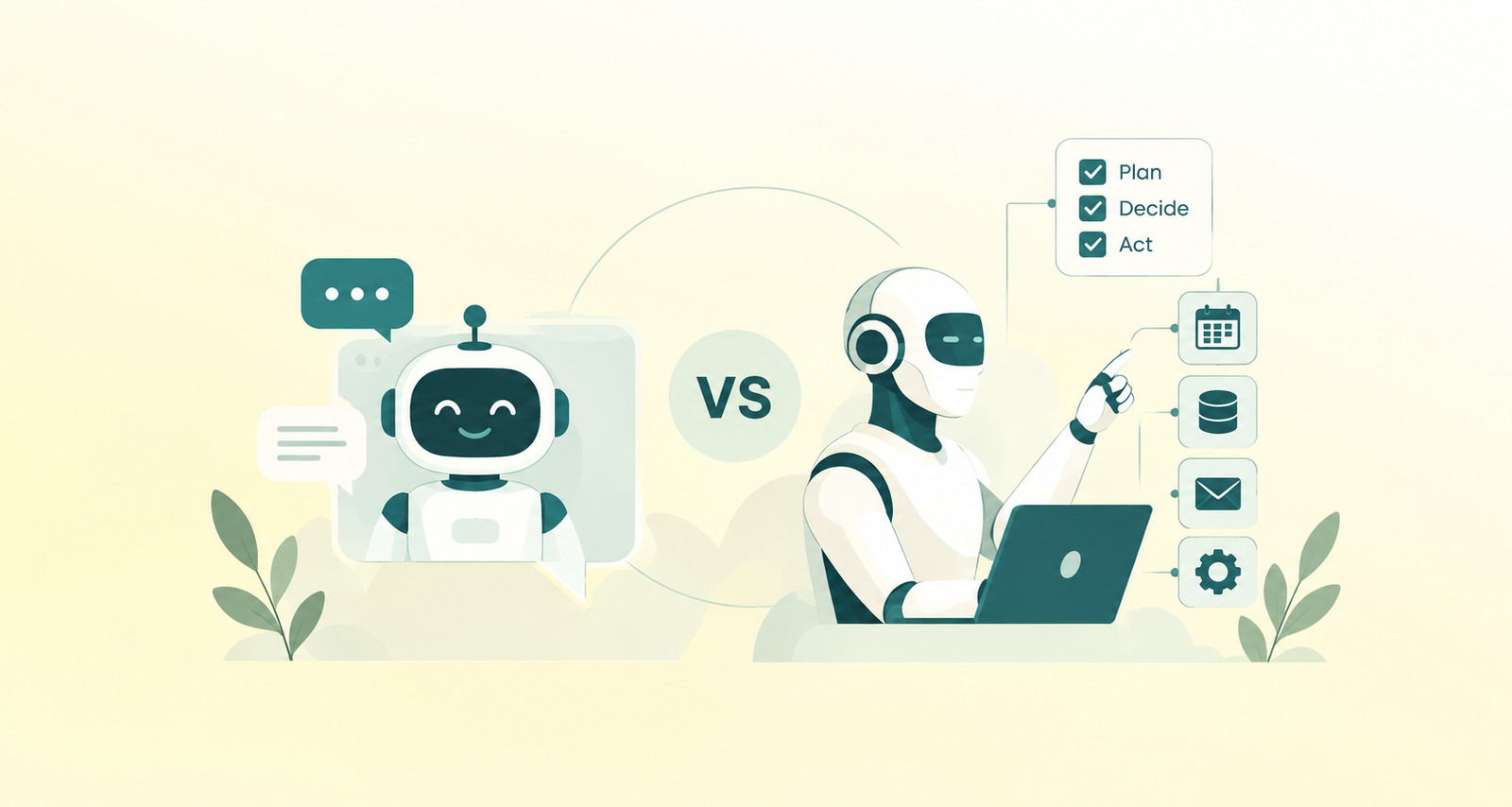
An AI chatbot is generally designed to have conversations with users and provide information or assistance. An AI agent can go a step further by understanding a goal, making decisions, using tools, and completing tasks with less human involvement.
For businesses considering AI automation, understanding this difference is important before deciding what to build.
What Is an AI Chatbot?
An AI chatbot is a software application that communicates with users through a conversational interface.
A customer might ask:
“What are your business hours?”
The chatbot can understand the question and provide the relevant answer.
Modern AI chatbots can do much more than traditional rule based chatbots. They can understand natural language, work with company information, answer questions about products or services, and maintain context during a conversation.
Common business uses include:
- Customer support
- Frequently asked questions
- Product recommendations
- Lead qualification
- Appointment information
- Internal employee assistance
- Website support
For example, a company website could have an AI chatbot that answers questions about services, pricing, delivery, or policies without requiring a member of the support team to respond manually.
The key point is that the conversation is usually the main purpose of the chatbot.
What Is an AI Agent?
An AI agent is designed to do more than simply respond to a conversation.
Instead of only answering a question, an agent can work toward a specific goal and take actions using connected tools and systems.
For example, imagine a customer says:
“I want to schedule a product demo next Tuesday afternoon.”
A chatbot might explain how the customer can book a demo.
An AI agent could potentially:
- Understand the request.
- Check the team’s calendar.
- Find available time slots.
- Suggest an appropriate time.
- Create the appointment.
- Send a confirmation email.
- Update the CRM.
The important difference is action.
An AI agent can be connected to APIs, databases, CRMs, calendars, business applications, and other tools to perform tasks instead of simply providing information.
AI Chatbot vs AI Agent
The easiest way to understand the difference is to look at what each system is expected to accomplish.
| AI Chatbot | AI Agent |
|---|---|
| Primarily communicates with users | Communicates and performs tasks |
| Answers questions | Works toward a goal |
| Usually follows a defined conversation | Can determine the next steps |
| Often focused on one interface | Can interact with multiple systems |
| Provides information | Can retrieve information and take action |
| Useful for customer conversations | Useful for business process automation |
An AI agent can include a chatbot style interface. In many business applications, the user talks to an AI agent through a chat interface while the agent handles the actual work in the background.
A Simple Business Example
Consider an online service company receiving dozens of inquiries every day.
A traditional chatbot could answer:
Customer: “Do you provide WordPress development?”
Chatbot: “Yes, we provide WordPress development services.”
That’s useful, but limited.
An AI agent could handle a larger part of the process:
Customer: “I need a new WordPress website for my business. Can you give me an estimate?”
The agent could ask about the number of pages, required functionality, integrations, design requirements, and timeline.
It could then collect the information, store the lead in a CRM, notify the sales team, and potentially prepare an initial project summary.
The AI isn’t simply answering the customer. It is helping move the business process forward.
When Is an AI Chatbot Enough?
Not every business needs an AI agent.
A chatbot can be a practical choice when your main requirement is to provide information or improve communication.
For example, a business may need a chatbot to:
- Answer common questions
- Explain services
- Help visitors find information
- Provide basic customer support
- Guide users through a website
- Collect basic lead information
If the task ends with an answer, a chatbot may be all you need.
Building a more complex agent when a simple chatbot can solve the problem may add unnecessary development and maintenance work.
When Does an AI Agent Make More Sense?
An AI agent becomes more useful when the business wants AI to interact with its existing systems and perform tasks.
Some examples include:
Sales
An agent can collect lead information, qualify prospects, update a CRM, and notify a salesperson.
Customer Support
An agent can look up customer information, check order status, create support tickets, and escalate complicated issues.
Operations
An agent can gather information from multiple systems and help employees complete repetitive operational tasks.
Scheduling
An agent can check availability, book appointments, send confirmations, and update calendars.
Data Processing
An agent can collect information, analyze it, organize it, and pass the results to another business system.
The possibilities depend heavily on the systems and APIs available to the business.
Do AI Agents Replace Chatbots?
Not necessarily.
It’s better to think of chatbots and agents as different levels of capability rather than direct replacements.
A chatbot can be the conversation layer, while an AI agent can provide the reasoning and action layer behind it.
For example:
User → Chat interface → AI Agent → CRM / Database / API / Calendar
The customer may only see a simple chat window. Behind that interface, the agent could be performing several actions.
This approach can create a much more useful experience without making the interface complicated for the user.
What Businesses Should Consider Before Building an AI Agent
AI agents can be powerful, but they should not be introduced simply because AI is popular.
Before building one, businesses should identify the actual problem they want to solve.
Ask:
What repetitive task are we trying to reduce?
What systems does the AI need to access?
What actions should it be allowed to perform?
Where should human approval be required?
What happens if the AI makes a mistake?
How will the business measure whether the automation is actually useful?
These questions help turn an interesting AI experiment into a practical business application.
AI Doesn’t Have to Mean a Huge System
One common misconception is that implementing AI requires building a completely new platform.
In reality, AI can often be added to an existing website or application.
For example, a business could start with:
Existing website → AI assistant → Company knowledge base
Later, it could expand into:
Website → AI agent → CRM → Email → Calendar → Internal systems
Starting with a clearly defined use case allows businesses to test the value of AI before investing in a larger system.
The Right Choice Depends on the Business Problem
There isn’t a universal answer to whether a business should use a chatbot or an AI agent.
If the requirement is primarily conversation and information, an AI chatbot may be enough.
If the requirement involves reasoning, connecting systems, and completing tasks, an AI agent may be more appropriate.
And in many cases, businesses can use both.
At BinaryGrace, we look at the workflow first and the technology second. Whether a business needs an AI powered website assistant, automation connected to existing systems, or a more complete AI
- difference between AI agents and chatbots
driven application, the starting point should always be the business problem.
Final Thoughts
AI chatbots and AI agents are becoming important tools for modern businesses, but they solve different problems.
A chatbot primarily helps businesses communicate with people.
An AI agent can help businesses get things done.
As AI becomes more connected with websites, CRMs, databases, APIs, and business applications, the distinction will become increasingly important for companies deciding where to invest.
The best starting point is simple: identify a repetitive or time-consuming business process, understand what parts can be automated, and then choose the right level of AI for the job.
That approach keeps technology practical and focused on real business value.
Looking to explore AI for your business? BinaryGrace can help you evaluate the workflow, technology requirements, and development approach before turning the idea into a working application.