Search is changing quickly.
For years, businesses focused on SEO to improve Google rankings, increase organic traffic and reach potential customers. SEO is still important, but people are increasingly discovering information through AI-powered search and conversational tools.
This has brought terms like AEO and GEO into the digital marketing conversation.
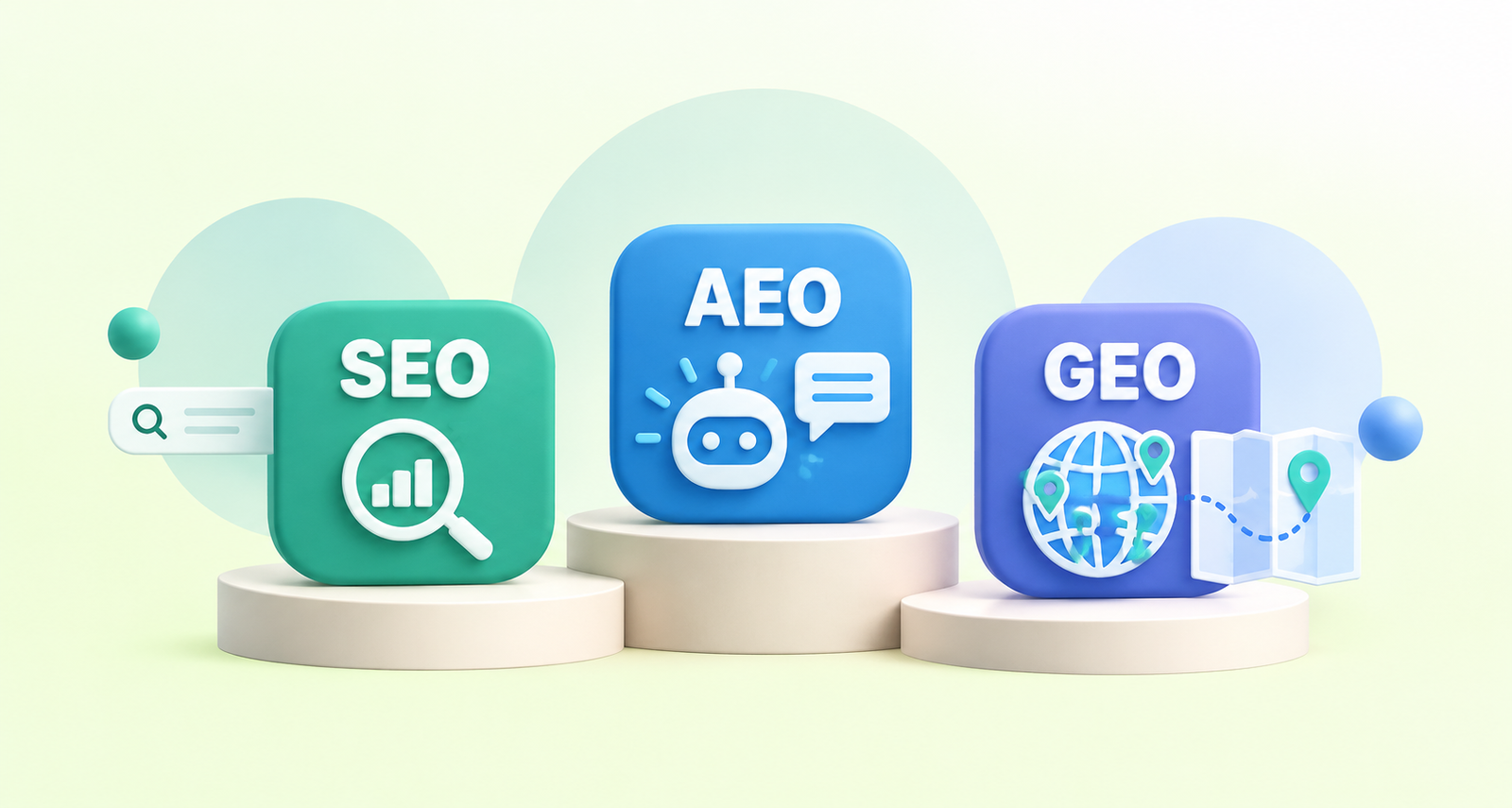
So, what is the difference between SEO vs AEO vs GEO? Do businesses need three separate strategies?
Not necessarily.
SEO, AEO and GEO have significant overlap. The main difference is how businesses think about visibility across traditional search engines, answer-based search and generative AI experiences.
In this guide, we’ll explain SEO vs AEO vs GEO, why these approaches matter in 2026 and how businesses can prepare their websites for the changing search landscape.
What Is SEO?
SEO stands for Search Engine Optimization.
It is the process of improving a website so search engines can crawl, understand and rank its pages for relevant searches.
Traditional SEO includes:
- Keyword research
- Search intent
- Technical SEO
- Website structure
- Page titles and meta descriptions
- Internal linking
- Content optimization
- Website performance
- Mobile usability
- Backlinks and authority
- Structured data
For example, a web development company might optimize a page for the keyword “WordPress development company.”
The objective is to make that page more relevant and useful for someone searching for WordPress development services.
SEO remains the foundation of online search visibility.
What Is AEO?
AEO stands for Answer Engine Optimization.
AEO focuses on creating content that directly answers questions users are asking through search engines and answer based platforms.
Traditional SEO might target:
WordPress development company
An AEO-focused approach might also target questions such as:
- How much does WordPress development cost?
- How long does it take to build a WordPress website?
- Should I choose WordPress or Webflow?
- What should I look for in a WordPress development company?
The goal is to provide clear, useful and well structured answers.
As search becomes more conversational, answering specific questions can become an important part of a broader search strategy.
What Is GEO?
GEO stands for Generative Engine Optimization.
GEO generally refers to optimizing a brand’s online presence so that it can be better understood and potentially referenced in generative AI experiences.
For example, a user might ask an AI platform:
“What should I look for when choosing a web development company?”
The response may contain explanations, recommendations and references to businesses or websites.
GEO focuses on improving the information available about a business and making its expertise easier for AI systems to understand.
The terminology around GEO is still developing, and different companies use the term in slightly different ways.
SEO vs AEO vs GEO: What Is the Difference?
The simplest way to understand the difference is to look at the primary focus of each approach.
| Approach | Main focus | Example goal |
|---|---|---|
| SEO | Search engines | Improve organic search visibility |
| AEO | Questions and answers | Provide useful answers to specific queries |
| GEO | Generative AI | Improve visibility and representation in AI-generated responses |
These strategies should not be treated as completely separate marketing activities.
In many cases, the same high-quality content can support SEO, AEO and GEO.
Why AEO and GEO Matter in 2026
The way people search for information is becoming more conversational.
Instead of typing several short keywords into a search box, users can ask longer and more detailed questions.
For example:
Traditional search:
WordPress website cost
Conversational search:
How much should a small business expect to pay for a professionally designed WordPress website?
The second query contains much more context.
AI-powered search experiences can interpret that context and provide a more conversational response.
This means businesses should think beyond individual keywords and consider the questions, problems and decisions their customers are trying to solve.
Google has continued expanding AI-powered features in Search, including AI Overviews and AI Mode, making AI search an increasingly important part of the search ecosystem.
Does AEO Replace SEO?
No.
AEO does not replace SEO.
GEO does not replace SEO either.
Strong technical SEO remains important because search engines and AI systems still need to discover and understand website content.
A strong website should therefore focus on:
- Crawlability
- Indexability
- Website performance
- Clear content
- Search intent
- Internal linking
- Structured information
- Relevant expertise
- Website authority
- User experience
AEO and GEO can be considered extensions of a broader search visibility strategy rather than replacements for traditional SEO.
How to Optimize Your Website for SEO, AEO and GEO
Businesses don’t necessarily need three completely separate strategies.
Instead, build a strong website foundation and create content that is useful for both people and modern search systems.
1. Create Content Around Real Customer Questions
Start with the questions your customers ask before contacting your business.
For a web development company, these could include:
- How much does a website cost?
- WordPress vs Webflow: which is better?
- How long does a website redesign take?
- Should my business use Shopify or WooCommerce?
- When should I build a custom web application?
- How can I improve my website’s search visibility?
These questions can become blog articles, FAQs, service-page sections and detailed guides.
2. Give Clear Answers
Don’t make users search through several paragraphs to find the answer.
Use clear headings and explain the main point early in each section.
For example:
What is AEO?
AEO, or Answer Engine Optimization, is the practice of creating and structuring content so it can clearly answer questions asked through search and answer-based platforms.
Then provide additional context.
This structure helps users scan the page and makes the information easier to understand.
3. Build Topic Authority
One article usually isn’t enough to establish strong topical coverage.
For example, a company offering WordPress development could publish content about:
- WordPress development
- WordPress SEO
- WordPress security
- WordPress speed optimization
- WordPress website redesign
- WordPress vs Webflow
- WordPress vs custom development
- WordPress website cost
These articles can be internally linked to relevant service pages.
4. Use Clear Website Structure
Your website should have a logical structure.
Use:
- Descriptive page titles
- H1, H2 and H3 headings
- Short paragraphs
- Lists
- Tables where useful
- Internal links
- Descriptive anchor text
- Relevant schema markup
Don’t add structured data simply because it is available. Use appropriate schema that accurately represents the page.
5. Strengthen Your Online Presence
Your own website is only one part of your digital presence.
Businesses should also maintain accurate and consistent information across relevant third-party platforms.
These can include:
- Business directories
- Industry websites
- Professional profiles
- Partner websites
- Reviews
- Case studies
- Publications
- Business listings
The information should be consistent and accurate wherever your company appears online.
6. Keep Your Website Technically Healthy
AI search doesn’t eliminate technical SEO.
Your website should still have:
- Fast-loading pages
- Mobile-friendly design
- HTTPS
- A valid XML sitemap
- Good internal linking
- Crawlable pages
- Correct canonical URLs
- Proper indexing
- No unnecessary broken links
- Appropriate structured data
Technical problems can make it harder for search engines and users to access your content.
SEO vs AEO vs GEO: Which One Should Your Business Focus On?
Instead of choosing one, businesses should look at the complete search journey.
Someone may discover your company through:
- Google Search
- Google AI Overviews
- Google AI Mode
- ChatGPT
- Gemini
- Perplexity
- Social media
- Industry websites
- Business directories
- Recommendations
The platforms may change, but the underlying goal remains the same:
Make your business easy to discover, understand and trust.
That starts with a strong website and useful content.
At BinaryGrace, we help businesses build and improve websites with a focus on performance, user experience, search visibility and long-term growth.
From WordPress and Webflow websites to Shopify, custom web development and SEO-focused improvements, we help businesses create a digital foundation that can adapt as the search landscape changes.
If your website is built for traditional search but hasn’t been reviewed for today’s AI driven search environment, 2026 is a good time to start.