Customer relationship management is changing quickly. Traditional CRM platforms have helped businesses organize contacts, track leads, manage sales pipelines, and record customer interactions for years. But modern businesses need more than a database and a collection of dashboards.
AI powered CRM systems are bringing intelligence into the entire customer journey.
Instead of simply storing information, an AI powered CRM can analyze customer data, identify patterns, summarize conversations, predict potential outcomes, automate repetitive tasks, and help sales teams decide what to do next.
For businesses looking to improve sales productivity and customer management, this shift from traditional CRM to intelligent CRM can create significant opportunities.
In this guide, we explore what an AI powered CRM is, how it works, its key benefits, practical use cases, implementation considerations, and how businesses can integrate AI into their existing CRM systems.
What Is an AI Powered CRM?
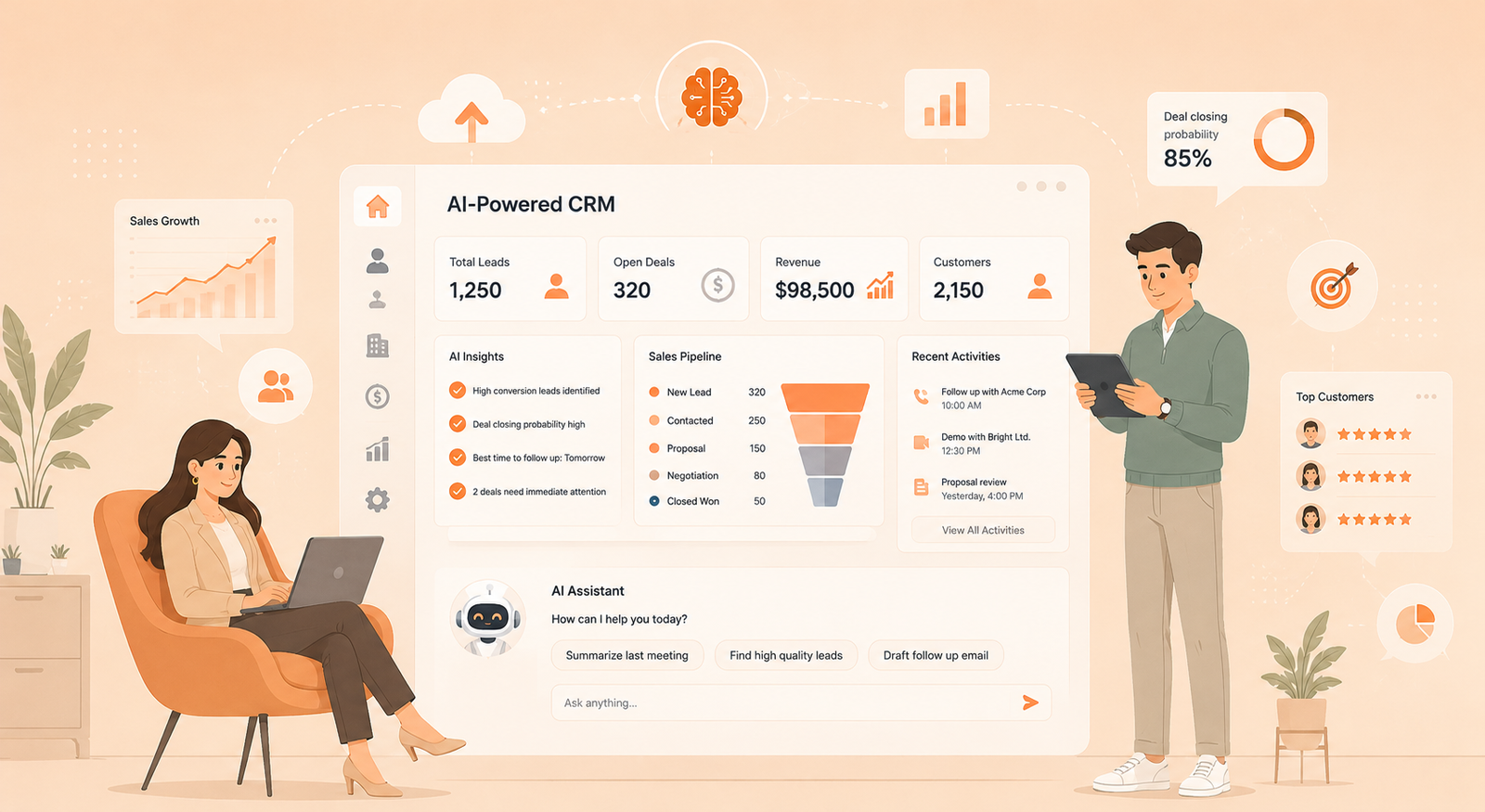
An AI powered CRM is a customer relationship management system that uses artificial intelligence and machine learning to analyze customer information, automate processes, generate insights, and assist employees with sales and customer management activities.
A traditional CRM primarily records information such as:
- Customer names and contact details
- Sales opportunities
- Communication history
- Tasks and reminders
- Deals and pipeline stages
- Customer support interactions
An AI-powered CRM goes a step further. It can analyze this information and help answer questions such as:
- Which leads are most likely to convert?
- Which customers may be at risk of leaving?
- What should a salesperson do next?
- Which deals require immediate attention?
- What information from previous conversations is important?
- Which customers are likely to need another product or service?
- Which sales activities are taking the most time?
- What patterns exist across successful and unsuccessful deals?
The key difference is simple:
Traditional CRM systems help businesses manage customer data. AI powered CRM systems can help businesses understand and act on that data.
Why Are Businesses Moving Toward AI Powered CRM?
Sales and customer management generate enormous amounts of information.
Emails, phone calls, meetings, website interactions, forms, support tickets, social conversations, purchase history, and marketing activities can all contain useful customer signals.
The challenge is that sales teams rarely have enough time to analyze all of this information manually.
This is where AI can help.
An intelligent CRM can process large amounts of customer data and turn it into practical recommendations. Instead of requiring employees to search through records, AI can surface relevant information at the right time.
For example, before a sales call, an AI powered CRM could generate a short summary containing:
- Previous conversations
- Customer requirements
- Open opportunities
- Past purchases
- Support issues
- Important contacts
- Recent website activity
- Recommended talking points
The salesperson can then spend less time searching for information and more time having a meaningful conversation.
AI-Powered CRM vs. Traditional CRM
The difference between traditional and AI powered CRM is not necessarily about replacing one system with another.
In many cases, AI can be added to an existing CRM.
| Traditional CRM | AI-Powered CRM |
|---|---|
| Stores customer information | Analyzes customer information |
| Manual data entry | Automated data capture |
| Static reports | Predictive insights |
| Manual lead qualification | AI assisted lead scoring |
| Manual follow ups | Automated follow up recommendations |
| Search based information retrieval | Natural language information retrieval |
| Standard dashboards | Intelligent recommendations |
| Manual conversation summaries | AI generated summaries |
| Rule based workflows | AI assisted workflows |
| Historical reporting | Predictive and contextual insights |
AI doesn’t eliminate the need for a CRM. Instead, it can make the CRM significantly more useful.
Key Features of an AI Powered CRM
AI can be integrated into different parts of a CRM depending on the business model, sales process, and available data.
1. AI Lead Scoring
Lead scoring is one of the most useful applications of AI in sales.
Traditional lead scoring often relies on predefined rules. For example, a company may assign points based on:
- Job title
- Company size
- Location
- Website visits
- Form submissions
- Email engagement
AI can analyze historical customer data and identify patterns associated with successful conversions.
The system can then help sales teams prioritize leads based on predicted conversion potential.
Instead of treating every lead equally, sales representatives can focus more attention on opportunities that are more likely to become customers.
2. Automated Customer Data Entry
Sales representatives spend considerable time updating CRM records.
AI can reduce this manual work by extracting useful information from emails, forms, conversations, documents, and other sources.
For example, an AI system could identify:
“The customer is interested in migrating their existing website to WordPress next quarter.”
The CRM could automatically associate this information with the relevant customer or opportunity.
This reduces repetitive data entry while helping keep customer records more complete.
3. AI Generated Meeting Summaries
Sales calls and customer meetings often contain valuable information.
However, manually writing detailed notes after every meeting takes time.
AI can transcribe and summarize conversations, identify important requirements, extract action items, and associate the information with the correct CRM record.
A sales representative could receive a summary such as:
Customer requirements
- New ecommerce website
- Shopify integration
- Existing ERP integration
Timeline
- Project expected to start in January
Next steps
- Send technical proposal
- Schedule follow-up call
This information can then become part of the customer’s CRM history.
4. Intelligent Follow Up Recommendations
Following up at the right time is critical in sales.
AI can analyze previous interactions and help determine when a lead may require attention.
For example, the CRM could identify:
“This opportunity has had no activity for 8 days. The customer previously indicated that pricing was the main decision factor.”
Instead of relying entirely on reminders, sales representatives receive contextual information that helps them decide what to do next.
5. AI Email Assistance
AI can help sales teams draft customer communications based on CRM context.
For example, the system may use:
- Previous conversations
- Customer requirements
- Deal stage
- Products or services discussed
- Meeting notes
- Customer preferences
The salesperson can then review and personalize the suggested message before sending it.
The goal should not be to send generic automated emails to everyone.
The goal is to help sales teams communicate faster while retaining a human touch.
6. Predictive Sales Forecasting
Sales forecasting is another area where AI can provide value.
Instead of relying only on manually updated pipeline stages, AI can analyze historical sales data and current opportunity activity.
Potential signals include:
- Deal age
- Communication frequency
- Customer engagement
- Previous purchasing behavior
- Sales stage
- Contract value
- Historical conversion rates
The system can then help identify opportunities that may be more or less likely to close.
This can give sales managers additional information when planning revenue forecasts.
7. Customer Churn Prediction
AI powered CRM systems can also help businesses identify customers who may be at risk of leaving.
Potential signals could include:
- Reduced product usage
- Fewer interactions
- Increasing support requests
- Payment issues
- Declining engagement
- Contract renewal approaching
When these signals appear together, the system can alert the customer success team.
The business can then take action before the customer decides to leave.
8. AI Customer Segmentation
Not every customer has the same needs.
AI can analyze customer behavior and identify meaningful segments based on factors such as:
- Purchase history
- Industry
- Company size
- Product usage
- Engagement
- Customer lifetime value
- Communication behavior
These segments can then support more personalized sales and marketing strategies.
9. Natural Language CRM Search
One of the most interesting developments in intelligent CRM systems is natural-language interaction.
Instead of navigating multiple CRM screens, a sales manager could ask:
“Which enterprise leads have not been contacted in the last two weeks?”
Or:
“Show me our highest-value customers whose contracts expire within 90 days.”
An AI-powered CRM can interpret the request and retrieve relevant information from connected CRM data.
This makes business information more accessible to non-technical users.
AI CRM Use Cases Across Different Departments
AI powered CRM is not limited to sales teams.
Sales
- Sales teams can use AI to:
- Prioritize leads
- Summarize meetings
- Automate CRM updates
- Identify sales opportunities
- Recommend follow-ups
- Analyze pipeline health
- Improve forecasting
Marketing
Marketing teams can use AI to:
- Segment customers
- Identify high-value audiences
- Personalize campaigns
- Analyze campaign performance
- Predict customer behavior
- Identify potential upsell opportunities
Customer Support
Support teams can use AI to:
- Summarize customer history
- Classify support requests
- Recommend responses
- Identify recurring issues
- Prioritize tickets
- Detect customers at risk of churn
Customer Success
Customer success teams can use AI to:
- Monitor customer engagement
- Identify renewal risks
- Recommend proactive outreach
- Analyze customer health
- Identify expansion opportunities
Management
Business leaders can use AI powered CRM insights to:
- Monitor sales performance
- Understand customer trends
- Forecast revenue
- Identify bottlenecks
- Evaluate team performance
- Make data-driven decisions
How AI CRM Integrates With Existing Business Systems
An AI powered CRM rarely operates in isolation.
Businesses often have multiple systems containing customer information.
These may include:
- CRM platforms
- ERP systems
- Ecommerce platforms
- Websites
- Marketing automation platforms
- Accounting software
- Customer support systems
- Email platforms
- Communication tools
- Internal databases
AI becomes more valuable when it can securely access relevant information across these systems.
For example:
Website → CRM → AI → Sales Team
A visitor submits a form on the website.
The CRM creates a lead.
AI analyzes the available information.
The system identifies the lead as high priority.
A sales representative receives the lead along with a summary and recommended next action.
This type of workflow can reduce manual work while improving response times.
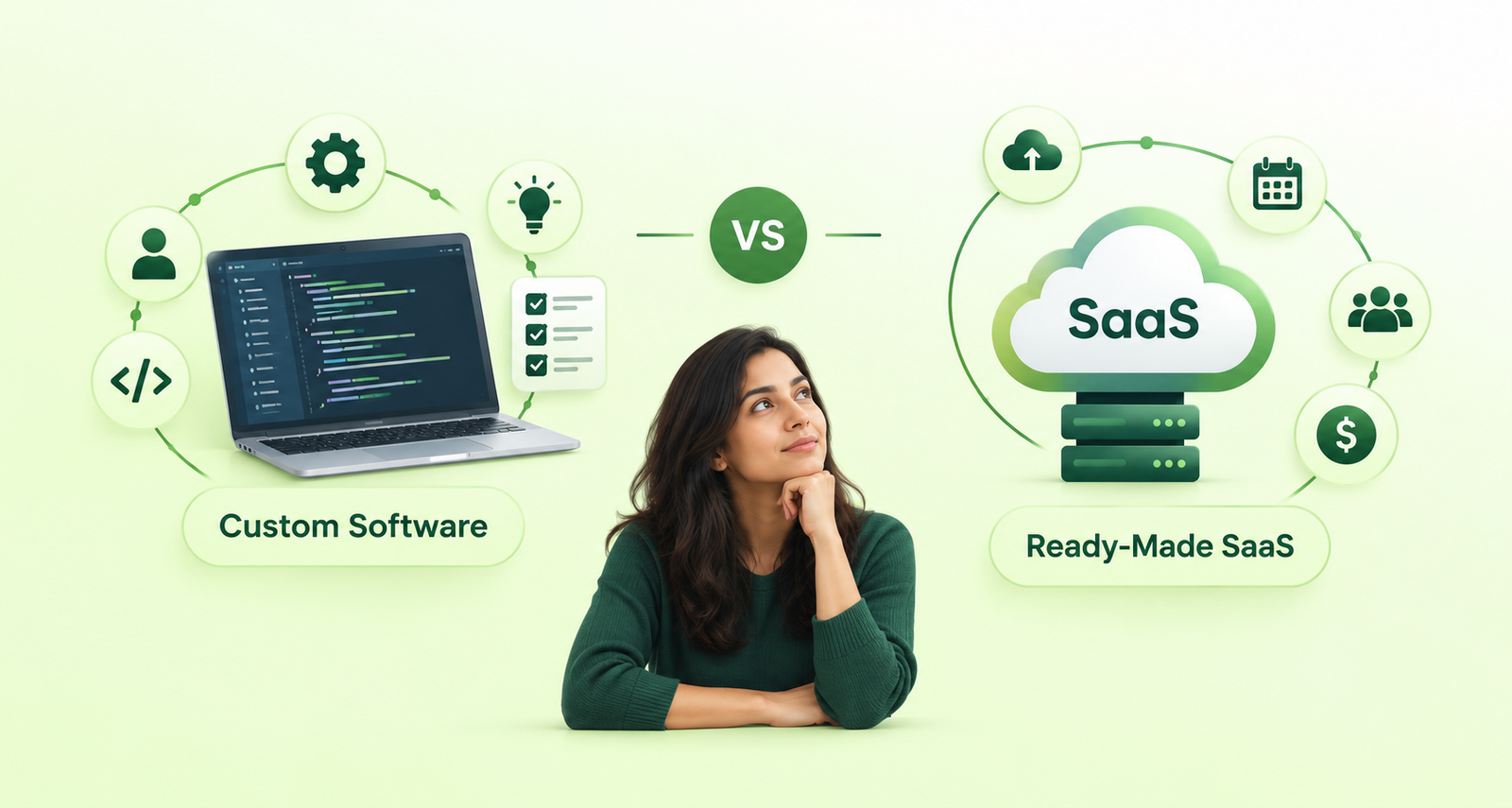
Should You Build an AI CRM or Add AI to Your Existing CRM?
This is one of the most important decisions for businesses considering AI.
Building an entirely new CRM may make sense when a company has highly specialized processes that existing platforms cannot support.
However, rebuilding everything is not always necessary.
For many businesses, a better approach is to enhance their existing CRM with AI capabilities.
For example, a business could keep its existing CRM while adding:
- AI lead scoring
- AI powered search
- Automated summaries
- Intelligent recommendations
- AI chat assistants
- Predictive analytics
- Automated workflows
- Custom integrations
This approach can reduce development time and allow businesses to introduce AI incrementally.
When Does Custom AI CRM Development Make Sense?
Custom CRM development can be valuable when standard CRM platforms don’t match the way a business operates.
A custom AI powered CRM may be appropriate when a company needs:
- Industry specific workflows
- Custom sales pipelines
- Complex approval processes
- Specialized reporting
- Integration with proprietary systems
- Custom customer portals
- AI powered internal assistants
- Advanced automation
- Custom dashboards
- Control over business data and infrastructure
For example, a logistics company may need a very different CRM workflow from a SaaS company or a professional services business.
Instead of forcing the business into a predefined workflow, custom development allows the CRM to be designed around the organization’s actual processes.
How to Implement AI in a CRM
AI implementation should start with a business problem rather than the technology itself.
Step 1: Identify Repetitive Processes
Start by identifying tasks that consume significant employee time.
Examples include:
- Manual CRM updates
- Lead qualification
- Meeting notes
- Customer segmentation
- Reporting
- Follow up reminders
Step 2: Identify Available Data
AI needs relevant data to provide useful results.
Evaluate:
- CRM records
- Customer interactions
- Sales history
- Support tickets
- Website data
- Documents
- Emails
- Product usage data
Step 3: Choose the Right AI Use Cases
Not every process needs AI.
Start with use cases where automation or intelligent analysis can produce measurable benefits.
Step 4: Integrate AI With Existing Systems
The AI layer should work with the systems employees already use wherever practical.
Step 5: Add Human Oversight
AI recommendations should not automatically become business decisions in every situation.
Human review remains important for:
- Customer communications
- Pricing decisions
- High-value sales opportunities
- Sensitive information
- Contract decisions
- Important customer issues
Step 6: Measure the Results
Track meaningful business metrics such as:
- Lead response time
- Conversion rate
- Sales productivity
- Customer retention
- CRM data quality
- Time saved
- Revenue per sales representative
This makes it easier to determine whether the AI implementation is actually delivering value.
Security and Privacy Considerations
AI powered CRM systems handle valuable business and customer information.
Security should therefore be considered from the beginning of the project.
Businesses should evaluate:
- Data access controls
- User permissions
- Encryption
- API security
- Data retention
- Authentication
- Audit logs
- Third-party AI providers
- Sensitive customer information
- Compliance requirements
AI should not become an additional security risk.
A well-designed architecture should define exactly what data AI systems can access, how that data is processed, and who can access the resulting information.
Challenges of AI Powered CRM
AI CRM systems offer significant benefits, but implementation isn’t without challenges.
Data Quality
AI depends heavily on the quality of the data it receives.
Incomplete, outdated, or inconsistent CRM records can reduce the usefulness of AI-generated insights.
Integration Complexity
Connecting CRM, ERP, ecommerce, marketing, support, and other systems can require careful technical planning.
AI Accuracy
AI generated recommendations and summaries should be reviewed and monitored, particularly for important business decisions.
Adoption
Even technically capable systems can fail if employees don’t use them.
The CRM experience should therefore be simple and aligned with existing workflows.
Cost
AI introduces additional development, infrastructure, API, and maintenance costs.
Businesses should prioritize high-value use cases rather than adding AI features simply because they are available.
How BinaryGrace Can Help With AI-Powered CRM Development
At BinaryGrace, we help businesses build and improve digital systems around their actual workflows.
AI can be integrated into an existing CRM or included as part of a custom CRM application, depending on the business requirements.
Our development capabilities include:
- Custom CRM development
- AI integration
- Business process automation
- CRM and ERP integrations
- API development
- Web application development
- AI-powered dashboards
- Customer portals
- Data processing and automation
- Custom AI assistants
- Third party system integrations
Our approach starts with understanding the business process, existing systems, data, and desired outcome.
From there, we can determine whether the right solution is to improve an existing CRM, integrate AI into the current workflow, or develop a custom CRM application.
Final Thoughts
AI-powered CRM systems are changing how businesses manage sales, customer relationships, and internal processes.
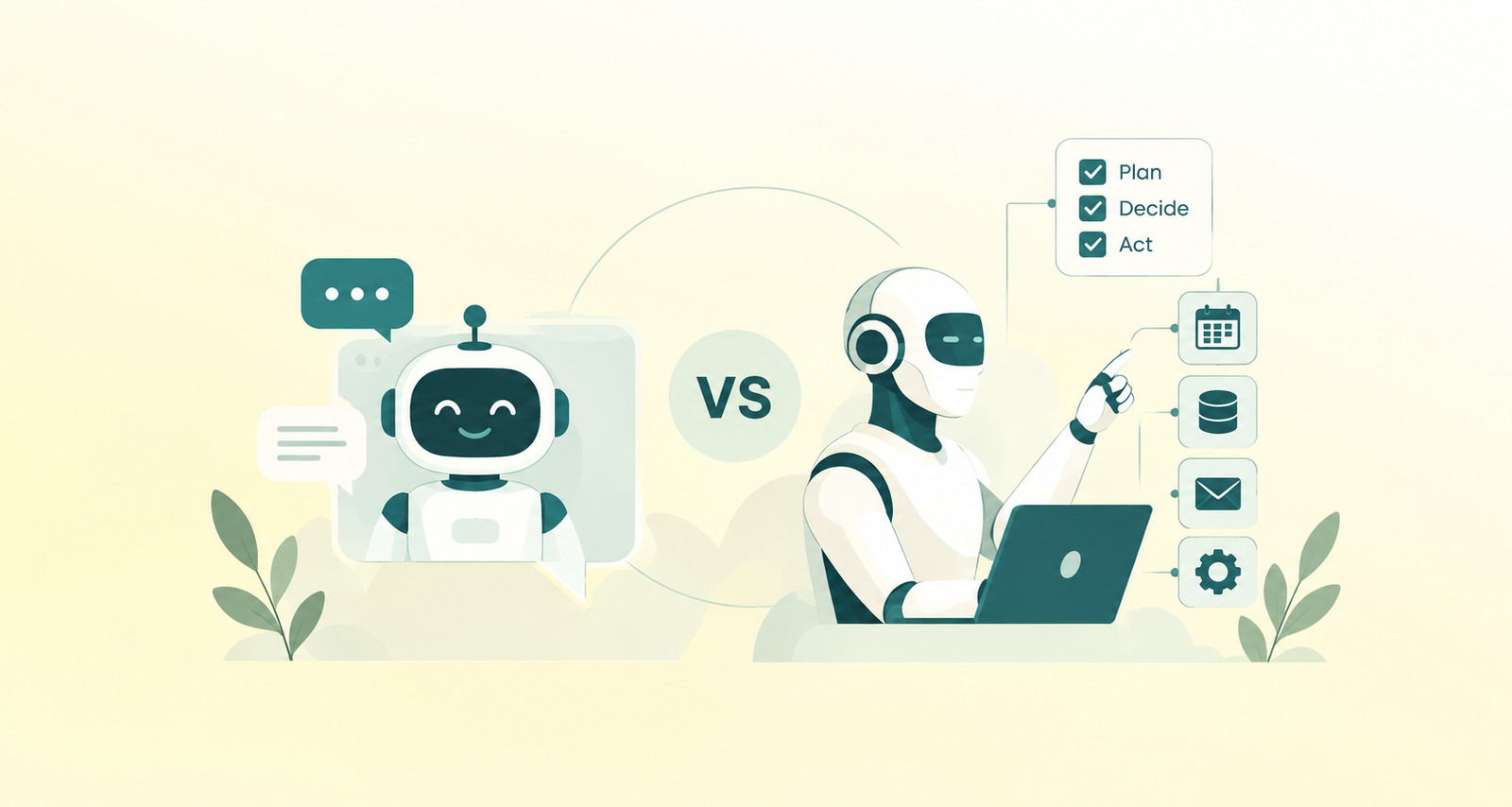
The biggest opportunity isn’t simply adding an AI chatbot to a CRM.
It is using AI to make customer information more useful, reduce repetitive work, identify important opportunities, and help teams make better decisions.
For some businesses, that may mean adding AI features to an existing CRM.
For others, it may mean building a custom AI-powered CRM around their unique processes.
The right approach depends on the business, its data, existing technology, and long-term goals.
The future of CRM isn’t just about storing customer information. It’s about turning that information into useful action.
If you’re exploring AI integration, CRM development, or business process automation, BinaryGrace can help you evaluate the right approach for your business.
About BinaryGrace
BinaryGrace is a web, mobile, and software development company helping businesses and agencies build practical digital products and technology systems.
Our work includes custom software, web applications, mobile apps, CRM and ERP systems, AI integration, automation, and digital solutions designed around real business requirements.
Have a CRM process you’d like to improve with AI? Talk to BinaryGrace about your requirements.