Every day, millions of websites generate valuable information product prices, real estate listings, business directories, competitor data, job postings, market trends, reviews, and more.
For businesses that rely on this information, manually collecting and updating data can quickly become expensive and time consuming.
This is where web data scraping can help.
Web data scraping allows businesses to automatically collect publicly available information from websites and convert it into structured, usable data. When implemented correctly, it can help companies reduce manual work, monitor competitors, improve market research, and build data-driven applications.
What Is Web Data Scraping?
Web data scraping is the process of automatically extracting information from websites using software.
Instead of manually visiting hundreds or thousands of web pages and copying information into a spreadsheet, a scraping system can collect the required data automatically.
For example, an eCommerce company may want to monitor:
- Product names
- Product prices
- Discounts
- Product availability
- Ratings and reviews
- Shipping information
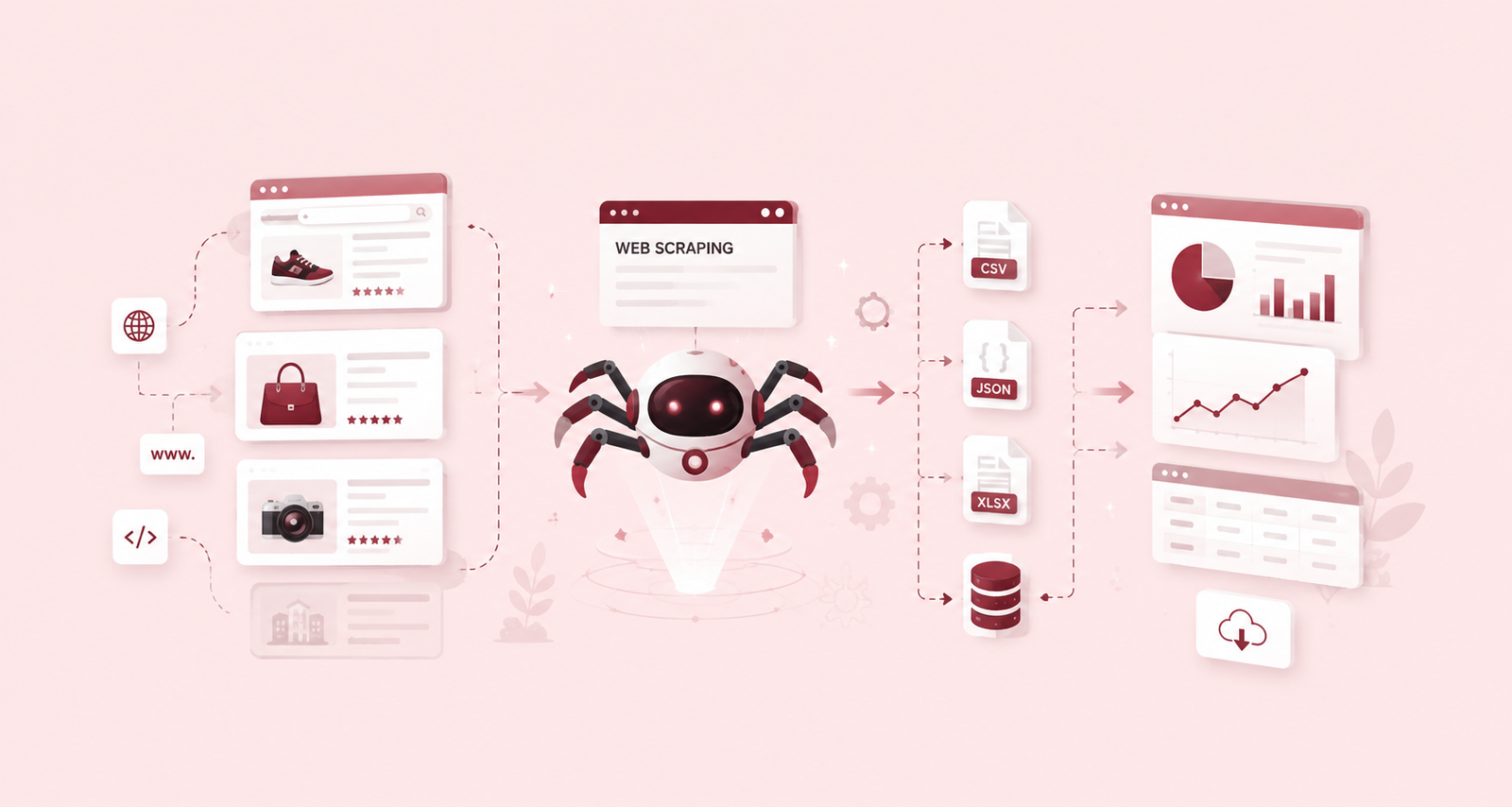
A custom scraper can collect this information from selected websites and store it in a structured format such as CSV, Excel, JSON, or a database.
The collected data can then be used for analytics, reporting, dashboards, internal systems, or other business applications.
How Does Web Scraping Work?
A typical web scraping solution involves several steps.
1. Identify the Data Sources
The first step is determining which websites contain the information your business needs.
Depending on the project, data may come from product websites, directories, marketplaces, real estate portals, job boards, news websites, or other publicly accessible sources.
2. Extract the Required Information
A scraping application visits the relevant pages and identifies specific data points.
For example, a real estate scraper could extract:
- Property title
- Location
- Price
- Property type
- Number of bedrooms
- Number of bathrooms
- Property size
- Listing URL
- Agent information
- Images
3. Clean and Structure the Data
Raw website data is not always ready to use.
The scraping system can clean duplicate records, normalize formats, remove unwanted information, and organize the data into a consistent structure.
4. Store the Data
The structured information can be stored in:
- MySQL
- PostgreSQL
- MongoDB
- Cloud databases
- CSV files
- Excel files
- JSON
- Data warehouses
- Custom business applications
5. Automate the Process
For businesses that need continuously updated information, scraping can be scheduled to run automatically.
For example, a system could collect updated product prices every six hours or check real estate listings once per day.
This turns a one-time scraping project into an ongoing data collection pipeline.
Why Do Businesses Use Web Data Scraping?
The biggest advantage of web scraping is automation.
Businesses can collect large amounts of information without relying on employees to manually perform repetitive tasks.
Competitive Price Monitoring
E-commerce businesses can monitor competitor pricing and promotions to understand market movements and make better pricing decisions.
Market Research
Companies can collect information from multiple online sources to identify market trends, customer demand, and emerging opportunities.
Lead Generation
Public business directories and websites can provide valuable information for building targeted prospect lists, subject to applicable laws, website terms, and privacy requirements.
Real Estate Data Collection
Real estate companies can collect publicly available property information from multiple sources and bring it together in a centralized system.
Job Market Monitoring
Recruitment companies can monitor publicly available job postings to identify hiring trends, positions, locations, and skills in demand.
Product Research
Retailers and marketplaces can use scraped product information to analyze competitors, product availability, pricing, and market trends.
Content and News Monitoring
Businesses can monitor publicly available news, articles, and industry publications to track relevant developments.
Web Scraping vs. Web Crawling
The terms web scraping and web crawling are often used interchangeably, but they are slightly different.
Web crawling focuses primarily on discovering and navigating web pages. Search engines, for example, crawl websites to discover and index pages.
Web scraping focuses on extracting specific information from those pages. A project can use both techniques together: a crawler can discover relevant pages, while a scraper extracts the required information.
What Makes a Good Web Scraping Solution?
A basic scraper may work for a small project, but business applications often require a more robust architecture.
A reliable scraping solution should consider:
Scalability
The system should be able to handle increasing numbers of websites, pages, and records without becoming difficult to maintain.
Data Accuracy
Extracted information should be validated and cleaned before being delivered to the business or stored in a database.
Scheduling
Automated schedules allow businesses to keep datasets updated without manually starting the scraping process.
Error Handling
Websites change frequently. A good scraping system should detect failed requests, missing fields, structural changes, and other issues.
Data Deduplication
Repeated scraping can produce duplicate records. Data processing rules can help identify and remove duplicates.
Monitoring
For large scale scraping projects, monitoring and logging are important for identifying failures and maintaining data quality.
Challenges of Web Data Scraping
Web scraping can look simple from the outside, but large scale projects can become technically complex.
Websites may use different technologies, page structures, JavaScript rendered content, pagination systems, authentication, or frequently changing layouts.
A scraper that works today may need updates when a website changes its structure.
Other challenges can include:
- Large volumes of data
- Dynamic websites
- Changing HTML structures
- Duplicate records
- Data normalization
- Request failures
- Performance optimization
- CAPTCHA and anti-bot systems
- Scheduling and monitoring
- Maintaining multiple data sources
This is why business-grade scraping solutions require more than simply extracting HTML from a webpage.
Is Web Scraping Legal?
Web scraping is not automatically illegal, but the legal and practical considerations depend on factors such as the source of the data, how the information is collected and used, applicable privacy laws, copyright considerations, and a website’s terms and technical restrictions.
Businesses should make sure their scraping activities comply with applicable laws and regulations and avoid collecting sensitive or restricted information without proper authorization.
For commercial projects, it is important to review the relevant website terms and obtain legal guidance when necessary.
When Should Your Business Consider Web Scraping?
Web scraping can be particularly valuable when:
- You need data from multiple websites.
- The same information must be collected regularly.
- Manual data collection takes significant time.
- Existing APIs do not provide the required information.
- You need to monitor competitors or market conditions.
- You want to build a centralized dataset.
- Your business application depends on regularly updated public web data.
If you only need a small amount of information once, manual collection may be more practical.
The value of scraping increases when the data is large, repetitive, or frequently updated.
Building a Custom Web Data Scraping Solution
At BinaryGrace, we develop custom web data scraping solutions based on the specific requirements of a business.
Instead of providing a one-size-fits-all scraper, we can build systems around the required data sources, extraction rules, data formats, storage requirements, and update frequency.
A typical solution can include:
- Website and data source analysis
- Custom scraping scripts
- Data extraction and transformation
- Data cleaning and normalization
- Database integration
- Scheduled scraping
- API integration
- Automated data pipelines
- Monitoring and error handling
- Custom dashboards and reporting
The technology used depends on the project requirements. Solutions may involve Python, Node.js, PHP, cloud infrastructure, databases, and other technologies.
Turn Web Data Into Business Value
Collecting data is only the first step.
The real value comes from what you do with that data.
A properly designed scraping system can feed information into your CRM, analytics platform, internal dashboard, marketplace, pricing system, or other business applications.
For example:
Website Data → Scraping → Data Cleaning → Database → Analytics → Business Decisions
This creates an automated data pipeline that can continuously transform publicly available web information into actionable business intelligence.
Final Thoughts
Web data scraping can help businesses automate repetitive data collection and create structured datasets from publicly available online information.
From competitive price monitoring and real estate research to lead generation and market intelligence, there are many potential applications.
However, successful scraping requires more than simply extracting information from a webpage. Scalability, data quality, maintenance, automation, monitoring, and compliance all need to be considered when building a production-ready solution.
If your business regularly relies on information available across multiple websites, a custom web data scraping solution may help you collect, organize, and use that data more efficiently.
Binary Grace can help you design and develop a custom web data scraping solution tailored to your data sources and business workflow.