A business website and a web application can look surprisingly similar from the outside. Both run in a browser, both can be accessed from a laptop or phone, and both can be built with modern web technologies.
But their purposes are very different.
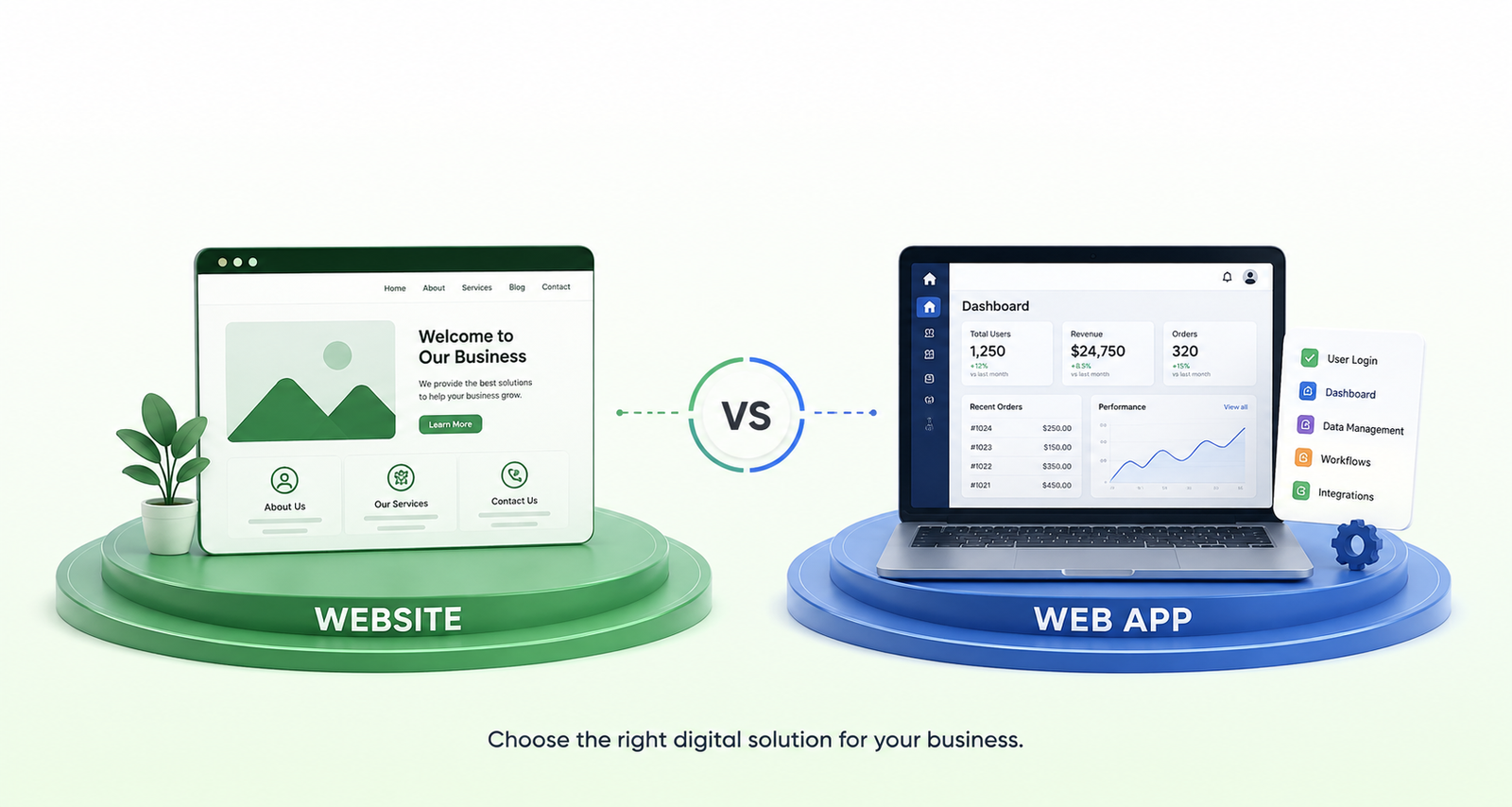
A website primarily communicates information, while a web app is designed to let users perform tasks, manage information, or interact with a system.
Choosing the right one can affect your development cost, timeline, maintenance requirements, and how easily your digital product can grow.
So, which one does your business actually need?
What Is a Website?
A website is primarily designed to provide information and help visitors understand your business, services, products, or brand.
Typical business websites include:
- Home
- About
- Services
- Products
- Case studies
- Blog
- Contact
- Testimonials
- FAQs
Visitors generally browse the content rather than perform complex actions.
For example, a consulting company may use its website to explain its services, showcase previous projects, publish insights, and allow potential customers to contact the team.
When a Website Makes Sense
A website is usually the right choice when your main objective is to:
- Build an online presence
- Generate leads
- Showcase products or services
- Publish content
- Establish credibility
- Improve search visibility
- Provide basic customer information
For many businesses, a well designed website is all they need to establish a strong digital presence.
What Is a Web App?
A web application is more interactive.
Instead of simply consuming information, users can log in, enter information, manage data, complete workflows, or interact with other users and systems.
Examples include:
- Customer portals
- Booking platforms
- CRM systems
- Project management tools
- SaaS platforms
- Online dashboards
- Membership platforms
- Marketplaces
- Internal business systems
- Quoting and estimation tools
For example, an online booking platform may allow customers to create an account, select a service, choose a date, make a payment, and manage their bookings.
That’s more than a traditional website. It’s an application delivered through the web.
Website vs Web App: The Key Difference
The simplest way to think about it is:
Website = information and communication
Web app = interaction and functionality
| Feature | Website | Web App |
|---|---|---|
| Informational content | ✓ | ✓ |
| Contact forms | ✓ | ✓ |
| Blog / content | ✓ | ✓ |
| User accounts | Sometimes | Usually |
| Dashboards | Rare | Common |
| Complex workflows | Limited | ✓ |
| Data management | Limited | ✓ |
| User-specific content | Limited | ✓ |
| Third-party integrations | Basic | Advanced |
| Automation | Limited | ✓ |
| Subscription functionality | Possible | Common |
The distinction isn’t always black and white. Modern websites can include sophisticated functionality, and some websites gradually evolve into web applications.
What About an eCommerce Website?
eCommerce is where the difference becomes less obvious.
An online store may look like a website, but behind the scenes it can contain many application-like features:
- Customer accounts
- Product management
- Shopping carts
- Checkout
- Payments
- Order management
- Inventory
- Discounts
- Shipping
- Notifications
A simple online store can often be built using platforms such as Shopify or WooCommerce.
A more complex commerce platform with custom pricing, multiple vendors, advanced workflows, subscriptions, or integrations may require significantly more custom application development.
So the question isn’t simply whether you’re building an eCommerce website.
It’s how much functionality your business requires behind the storefront.
Questions to Ask Before Choosing
Before deciding between a website and web app, consider what your users actually need to do.
1. Do users need to create accounts?
If visitors simply need to read information or contact your business, a website may be enough.
If they need personal profiles, saved information, dashboards, or account-specific functionality, you’re moving toward a web app.
2. Does your business need a dashboard?
A dashboard is often a strong indicator that you’re building an application.
For example, you might need separate dashboards for:
- Customers
- Employees
- Managers
- Administrators
- Vendors
- Partners
Each user may see different information and have different permissions.
3. Will users interact with your data?
If users need to create, edit, search, filter, upload, or manage information, a web application may be the better approach.
4. Do you need automation?
Consider whether your system needs to automatically:
- Generate documents
- Send notifications
- Calculate prices
- Process orders
- Assign tasks
- Update records
- Sync data between platforms
The more business logic you introduce, the more likely you are moving beyond a standard website.
5. Will your system integrate with other platforms?
APIs can connect your digital product with payment gateways, CRMs, accounting platforms, shipping systems, analytics tools, AI services, and other software.
Basic integrations can work perfectly well with websites, but complex integrations are more common in web applications.
Can You Start With a Website and Build an App Later?
Yes.
In fact, this can be a sensible approach for many businesses.
You don’t necessarily need to build a complex platform on day one.
For example, a business could start with:
Phase 1: Marketing website
↓
Phase 2: Customer login and portal
↓
Phase 3: Online payments and bookings
↓
Phase 4: Dashboard and automation
↓
Phase 5: Full web application
This approach allows the business to validate demand before investing heavily in custom functionality.
However, the future roadmap should be considered from the beginning. A website that is expected to eventually become an application should be planned with an appropriate technical architecture.
What About Cost?
There is no single price for either a website or web app.
A business website can range from a relatively simple informational site to a highly customized enterprise experience.
Web applications generally require a larger investment because they involve additional development such as:
- Authentication
- Databases
- User roles
- Business logic
- APIs
- Security
- Admin panels
- Automated processes
- Testing
- Infrastructure
The important thing is not to choose the cheapest technology.
Instead, choose the simplest technology that can properly support your business requirements.
Building a complex application when you only need a website wastes resources.
Building a basic website when your business actually requires an application can create limitations later.
A Simple Decision Framework
Ask yourself one question:
What do you want visitors to do?
If the answer is primarily:
“Learn about our business, view our services, read our content, and contact us.”
→ You probably need a website.
If the answer is:
“Log in, manage information, make bookings, complete transactions, use a dashboard, or perform specific workflows.”
→ You may need a web application.
And if you need both, you don’t necessarily have to choose.
Many businesses benefit from having a marketing website connected to a web application.
The Bottom Line
The difference between a website and a web app isn’t simply about how they look.
It’s about what the system needs to do.
A website is often the best starting point for businesses focused on visibility, content, branding, and lead generation.
A web app becomes more appropriate when users need to interact with data, complete workflows, access personalized information, or use business specific functionality.
Before starting development, define the users, workflows, integrations, and business goals first. The technology should follow those requirements not the other way around.
At BinaryGrace (Binary Grace), we approach web projects by first understanding what the business needs to accomplish, then selecting the appropriate platform, architecture, and technology for the job.