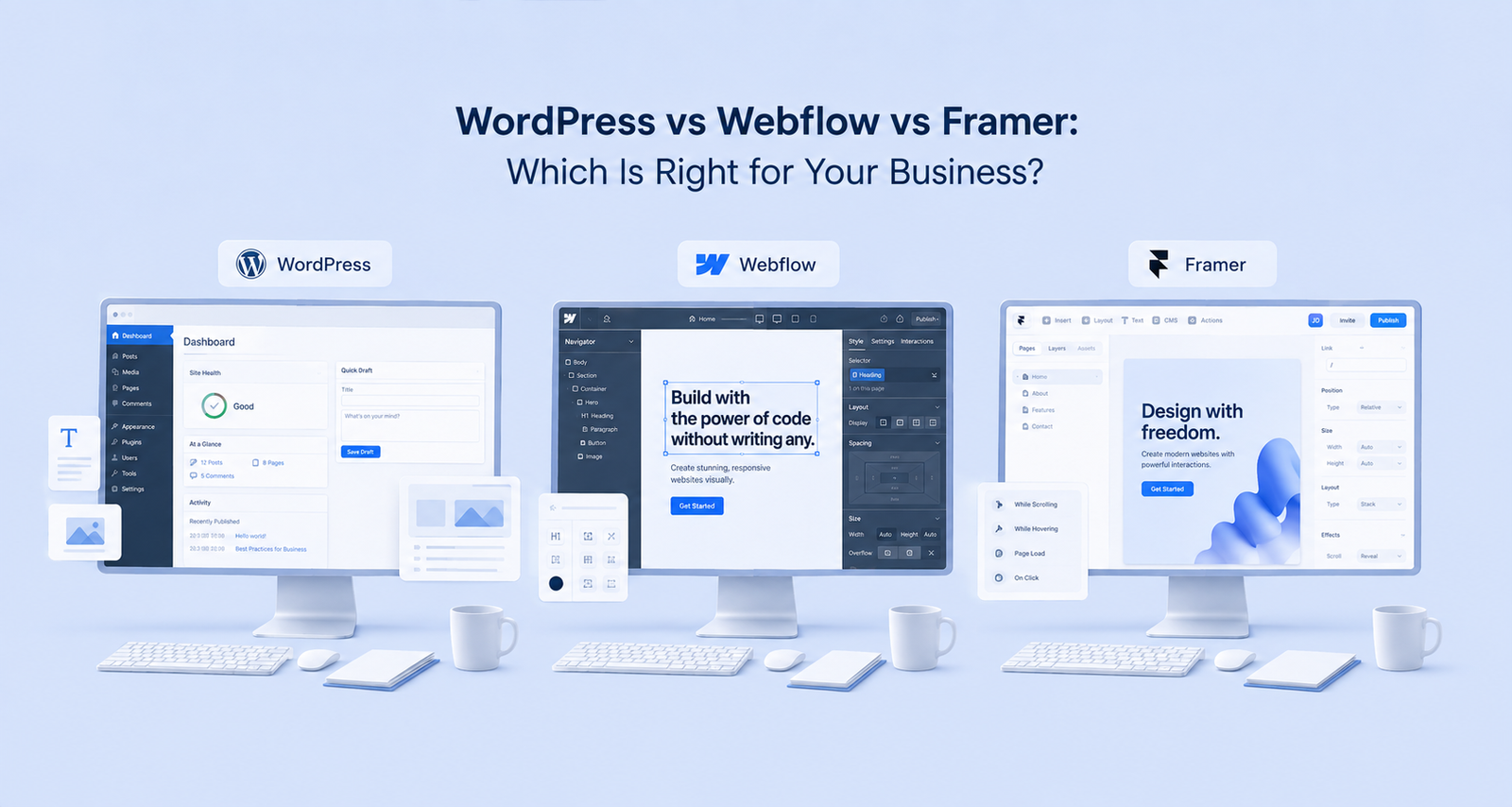
Choosing a platform for your business website can feel more complicated than it should.
You may have heard that WordPress is flexible, Webflow gives designers more control, and Framer is fast and modern. All three can produce excellent websites, but they are built with different priorities in mind.
The right choice isn’t necessarily the platform with the most features. It’s the one that fits your business goals, content, budget, team, and plans for the future.
So, if you’re wondering whether you should choose WordPress, Webflow, or Framer, let’s break it down in simple terms.
What Is WordPress?
WordPress is one of the most established website platforms available today.
Originally created as a blogging platform, WordPress has evolved into a flexible content management system that can support everything from a small business website to a large publishing platform or eCommerce store.
One of WordPress’s biggest advantages is its flexibility.
You can extend a WordPress website using themes, plugins, custom development, APIs, custom fields, and tools such as WooCommerce.
WordPress can be a strong choice if your business needs:
- A content heavy website
- A blog or publishing platform
- Advanced SEO control
- eCommerce
- Membership functionality
- Custom forms
- Third-party integrations
- Custom content types
- Complex website functionality
For businesses that want control and room to grow, WordPress remains a strong option.
The downside of WordPress
Flexibility also comes with responsibility.
Plugins, themes, WordPress core updates, security, backups, hosting, and performance all need to be managed properly.
A well-built WordPress website can be fast, secure, and reliable.
A website built with too many unnecessary plugins or poorly maintained components can become difficult to manage.
That’s why the quality of the implementation matters just as much as the platform itself.
What Is Webflow?
Webflow takes a different approach to website development.
It combines visual design with a structured development environment, giving designers considerable control over layouts, responsive behavior, animations, interactions, and content.
Webflow is particularly attractive to businesses that care heavily about design and brand presentation.
It can work well for:
- Corporate websites
- SaaS marketing websites
- Startup websites
- Agency websites
- Product websites
- Landing pages
- Design-focused business websites
One of Webflow’s biggest advantages is the relationship between design and development.
Designers can build highly customized layouts while maintaining more control over the underlying structure than they typically would with traditional drag and drop website builders.
The downside of Webflow
Webflow isn’t designed to handle every possible type of business functionality.
If your project requires highly customized application logic, complex workflows, extensive eCommerce functionality, or unusual integrations, you may eventually need custom development or external systems.
For a marketing focused website, however, Webflow can be an excellent choice.
What Is Framer?
Framer has become increasingly popular for modern marketing and design-focused websites.
Its visual interface makes it possible to create polished layouts, animations, interactions, and responsive experiences relatively quickly.
Framer is particularly appealing when speed and visual presentation are important.
It can work well for:
- Startup websites
- Landing pages
- Creative businesses
- Personal brands
- Portfolio websites
- Product launches
- Marketing websites
One of Framer’s biggest advantages is how quickly a designer can move from an idea to a working website.
For a startup that needs a polished marketing website without a long development cycle, this can be very attractive.
The downside of Framer
Framer isn’t necessarily the right choice for every business.
If your website requires extensive eCommerce functionality, complex user accounts, advanced business workflows, or a highly customized backend, WordPress or a custom web application may be more appropriate.
WordPress vs Webflow vs Framer: What’s the Real Difference?
The biggest difference isn’t simply how the platforms look.
It’s what they are designed to help you accomplish.
WordPress focuses heavily on flexibility, content management, integrations, and extensibility.
Webflow combines visual design with structured website development and is particularly strong for sophisticated marketing websites.
Framer focuses heavily on modern design, interactions, and getting polished marketing websites online quickly.
None of these platforms is automatically better than the others.
The better question is:
What does your business actually need from its website?
WordPress: Best for Flexibility
If your website is likely to become an important part of your business operations, WordPress can provide considerable flexibility.
Webflow: Best for Design-Focused Websites
Webflow can be a great fit when the website itself is an important part of the brand experience.
Framer: Best for Modern Marketing Websites
Framer is particularly interesting for businesses that want to move quickly.
Choose WordPress if:
You need flexibility, advanced content management, eCommerce, integrations, or custom functionality.
It’s particularly suitable for businesses that expect their website to evolve over time.
Choose Webflow if:
You want a high-quality, design focused marketing website with strong visual control and structured CMS capabilities.
It’s a strong option for SaaS companies, agencies, startups, and established brands.
Choose Framer if:
You want a modern, visually impressive website that can be designed and launched quickly.
It’s particularly suitable for startups, creative businesses, portfolios, and marketing campaigns.
Final Thoughts
There isn’t a universal winner in the WordPress vs Webflow vs Framer debate.
Each platform has its strengths.
WordPress is the flexible all-rounder.
Webflow is a strong choice for design-focused and structured marketing websites.
Framer is excellent for modern, visually driven websites that need to move quickly.