Choosing the right eCommerce platform is an important decision for any business planning to sell products online. Your platform affects more than just how your store looks. It influences website performance, operating costs, search visibility, customer experience, and how easily your business can grow.
Shopify and WooCommerce are two popular platforms for building online stores. Both provide the essential tools needed to manage products, process orders, accept payments, and sell online. However, they offer different levels of flexibility, control, and technical management.
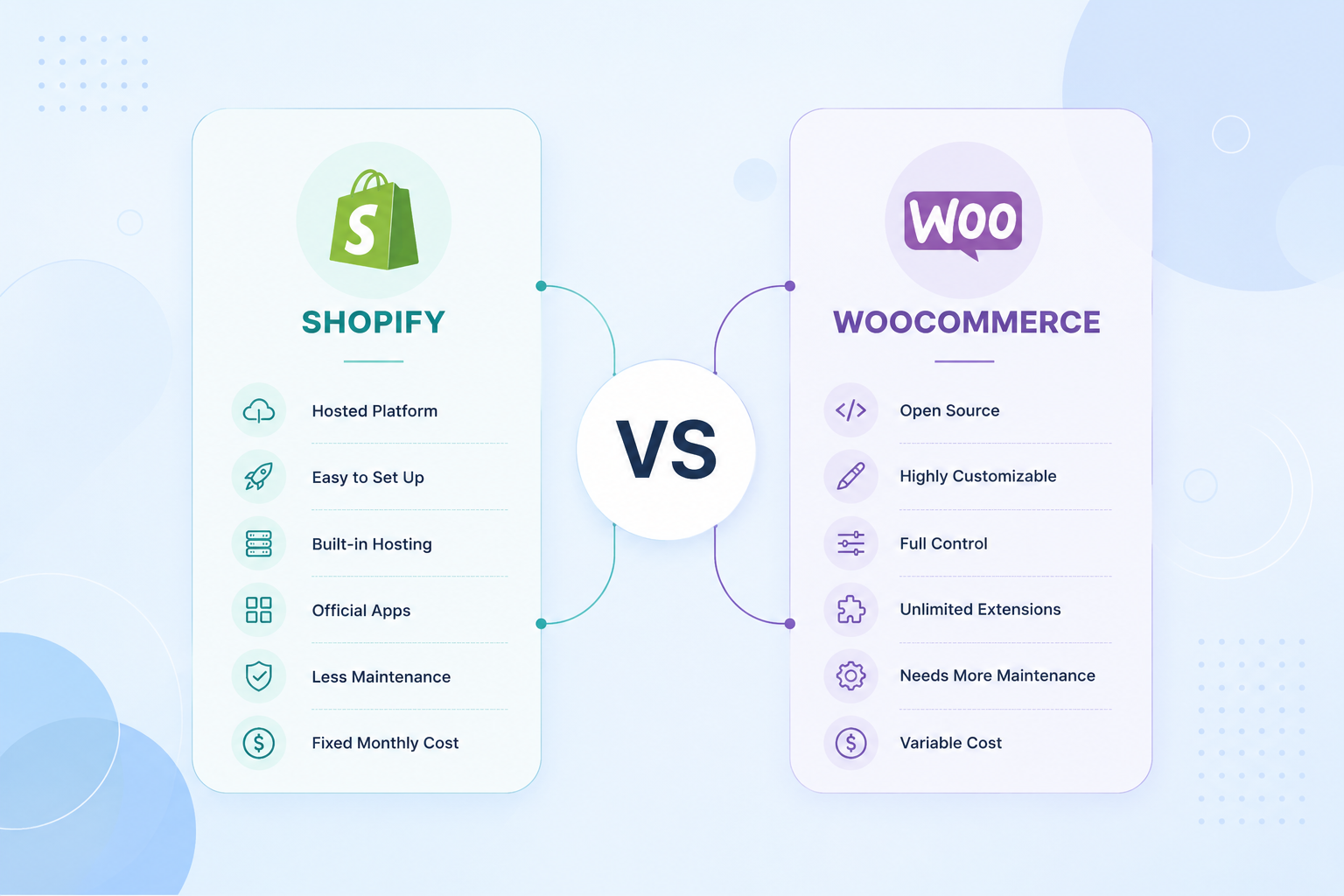
Shopify is a hosted eCommerce platform designed to simplify store management, while WooCommerce is an open-source eCommerce solution built on WordPress that offers greater control over website functionality and infrastructure.
So, which platform is better for growing businesses?
In this guide, we compare Shopify vs WooCommerce across pricing, customisation, SEO, AI search visibility, performance, security, and scalability to help you choose the right platform for your business.
Shopify vs WooCommerce: Quick Comparison
The main difference between Shopify and WooCommerce is how they manage an online store.
Shopify provides a managed platform where hosting, security, and core eCommerce functionality are included. WooCommerce gives businesses greater control over their website but requires separate hosting and ongoing technical management.
| Feature | Shopify | WooCommerce |
|---|---|---|
| Platform type | Hosted SaaS | Open-source |
| Initial platform cost | Paid subscription | Free core plugin |
| Hosting | Included | Purchased separately |
| Setup | Generally easier | Requires WordPress setup |
| Customisation | Themes, apps and code | Extensive customisation |
| SEO flexibility | Good | Extensive |
| Security management | Platform-managed infrastructure | Website owner-managed |
| Performance | Managed infrastructure | Depends on hosting and optimisation |
| Integrations | Shopify apps and APIs | Plugins, extensions and APIs |
| Maintenance | Less technical maintenance | Requires regular maintenance |
| Scalability | Managed platform scaling | Depends on infrastructure |
| Best suited for | Convenience and managed commerce | Flexibility and custom requirements |
Neither platform is automatically better for every business. The right choice depends on your operational requirements, budget, technical resources, and long-term growth plans.
1. What Is Shopify?
Shopify is a hosted eCommerce platform that allows businesses to create and manage online stores without handling their own hosting infrastructure.
It provides a central dashboard for managing products, inventory, orders, customers, payments, discounts, and sales channels.
Since Shopify manages the core platform infrastructure, businesses do not need to independently configure servers, install platform updates, or manage many of the technical aspects of hosting.
Some of its key features include:
- Hosted online store with SSL security.
- Product, inventory, and order management.
- Integrated checkout and payment gateway options.
- Customisable storefront themes.
- App marketplace for additional functionality.
- Social media and sales channel integrations.
- Built-in analytics and reporting.
- Multi-currency and international selling features, subject to regional availability.
Shopify is particularly suitable for entrepreneurs, retail brands, and businesses that want to launch and manage an online store without significant technical involvement.
2. What Is WooCommerce?
WooCommerce is an open-source eCommerce plugin built for WordPress. It transforms a standard WordPress website into a fully functional online store.
Unlike Shopify, WooCommerce does not include hosting. Businesses choose their hosting provider, domain, security configuration, and website infrastructure.
One of WooCommerce’s biggest advantages is its flexibility. Developers can customise product pages, checkout workflows, pricing rules, payment integrations, and backend functionality according to business requirements.
Its main features include:
- Physical and digital product management.
- Flexible product variations and configurations.
- Multiple payment gateway integrations.
- Extensions for subscriptions, bookings, and memberships.
- Integration with WordPress blogging and content management.
- Custom API integrations.
- Flexible SEO configuration through WordPress tools.
- Greater control over website code and infrastructure.
WooCommerce is particularly useful for businesses that need specialised eCommerce functionality or want their online store to work closely with an existing WordPress website.
3. Pricing: Which Platform Is More Affordable?
Cost is often one of the first considerations when comparing Shopify vs WooCommerce. However, looking only at the monthly subscription or initial software cost can give an incomplete picture.
The actual cost of running an online store includes hosting, themes, applications, payment processing, development, maintenance, and future upgrades.
Shopify pricing
Shopify follows a subscription based pricing model. Hosting and core eCommerce infrastructure are included in its plans.
Apart from the subscription, businesses may need to pay for:
- Premium themes.
- Paid applications.
- Third-party payment gateway charges.
- Additional development and customisation.
- Marketing and automation tools.
One important consideration for Indian businesses is payment gateway availability. Shopify Payments is not currently available for India-based merchants, so businesses generally need to use supported third-party payment providers. Applicable third-party transaction fees should also be considered.
You can check current plans on the official Shopify pricing page.
WooCommerce pricing
WooCommerce’s core plugin is free, but building and operating a store involves several other expenses.
These may include:
- Domain registration.
- Web hosting.
- Premium themes.
- Paid plugins and extensions.
- Custom development.
- Security and maintenance.
- Payment gateway processing charges.
The overall investment depends on the size and complexity of the store.
A small online store with standard products may require relatively little additional functionality. However, a larger store with custom checkout workflows, advanced inventory management, ERP integrations, or specialised product configurations may require a more substantial development budget.
Which is cheaper?
There is no universal winner.
Shopify provides more predictable infrastructure costs, while WooCommerce allows businesses to select their hosting and control their software expenses.
Businesses should compare the total cost of ownership over 12–24 months rather than simply comparing subscription fees.
4. Customisation and Design Flexibility
Your online store should reflect your brand and provide a smooth shopping experience. Both platforms support professional storefront designs, but their customisation approaches are different.
Shopify customisation
Shopify offers ready made themes and a theme editor that allows businesses to customise layouts, colours, typography, images, and page sections.
Its app ecosystem provides additional functionality without requiring everything to be developed from scratch.
For advanced requirements, developers can customise themes using Shopify’s supported development tools and APIs.
However, certain platform-level limitations may affect how deeply you can customise checkout, backend functionality, and commerce workflows, depending on your subscription plan.
WooCommerce customisation
WooCommerce offers extensive customisation possibilities because it operates within WordPress.
Developers can modify templates, create custom plugins, extend product functionality, customise checkout fields, and build unique shopping experiences.
For example, a business selling customised furniture may need dynamic pricing based on dimensions, material selections, product variations, and delivery requirements.
These requirements can be addressed through suitable WooCommerce extensions or custom development.
Which offers better flexibility?
WooCommerce generally provides greater code level control and flexibility. Shopify is a strong choice when you want a professional storefront with less technical complexity.
If your business requires specialised functionality or a highly customised shopping experience, WooCommerce may offer more freedom.
5. SEO, GEO and AEO: Which Platform Is Better for Search Visibility?
Search engine visibility is important for eCommerce businesses that want to attract customers without relying entirely on paid advertising.
Today, search is also expanding beyond traditional search engine results. Customers increasingly discover products and businesses through AI-powered search experiences and conversational platforms.
This makes SEO, Answer Engine Optimisation (AEO), and Generative Engine Optimisation (GEO) important considerations when selecting an eCommerce platform.
Shopify SEO capabilities
Shopify provides several built-in SEO features, including:
- Custom page titles and meta descriptions.
- Editable URL handles.
- Automatic XML sitemaps.
- Canonical tags.
- SSL certificates.
- Image alt text.
- Mobile-responsive themes.
- Built-in blogging functionality.
Businesses can also use applications and additional development to extend SEO capabilities.
WooCommerce SEO capabilities
WooCommerce benefits from the WordPress ecosystem, which provides extensive control over website content and technical SEO.
With plugins such as Rank Math and Yoast SEO, businesses can manage:
- SEO titles and meta descriptions.
- XML sitemaps.
- Canonical URLs.
- Schema markup.
- Breadcrumbs.
- Redirects.
- Robots directives.
- Image optimisation.
- Content optimisation and internal linking.
Developers can also customise structured data, product information, category pages, and other technical SEO elements.
What about GEO and AEO?
GEO focuses on improving content discoverability and understanding across generative search platforms, while AEO focuses on providing clear answers to specific user questions.
For eCommerce websites, this means maintaining accurate product information, useful descriptions, clear category structures, and helpful supporting content.
WooCommerce provides greater flexibility for content-led strategies because it combines eCommerce functionality with the full WordPress content management system.
Shopify also supports SEO and product discovery through its managed commerce environment and integrations.
However, neither platform guarantees visibility in Google AI Overviews, ChatGPT, Gemini, or other AI-powered search experiences.
Content quality, structured information, website accessibility, brand credibility, and technical implementation remain important regardless of the platform.
Our recommendation: WooCommerce offers an advantage for businesses investing heavily in blogging, content marketing, and advanced technical SEO. Shopify is also a strong option for businesses prioritising managed eCommerce and straightforward search optimisation.
6. Performance, Security and Scalability
As an online store grows, it needs to handle increasing website traffic, product listings, customer activity, and orders without compromising the shopping experience.
Shopify performance and security
Shopify manages its hosting infrastructure, platform updates, and core security environment.
This reduces the technical maintenance burden for store owners.
However, themes, third-party applications, large images, and unnecessary scripts can still affect storefront performance.
WooCommerce performance and security
WooCommerce performance depends heavily on the hosting environment and website configuration.
A properly developed WooCommerce website can deliver excellent performance, even with complex functionality.
Important considerations include:
- Choosing suitable hosting infrastructure.
- Implementing server-side caching.
- Using a content delivery network.
- Optimising images and media.
- Reducing unnecessary plugins.
- Optimising database queries.
- Monitoring Core Web Vitals.
- Maintaining WordPress, themes, and plugins.
Businesses are also responsible for maintaining backups, security monitoring, SSL configuration, and access controls.
7. Payments and Third-Party Integrations
Payment flexibility is essential for businesses selling across different regions.
Shopify and WooCommerce both support multiple payment gateway integrations, although availability depends on the merchant’s location and payment provider.
Shopify provides supported third-party payment providers that can be connected through its platform. Businesses should review gateway availability and any additional transaction charges before choosing a plan.
WooCommerce supports multiple payment gateway extensions and allows developers to build custom payment integrations where standard extensions do not meet business requirements.
Depending on regional availability, businesses may integrate providers such as Razorpay, PayU, Stripe, and PayPal.
Both platforms can also connect with external services such as:
- CRM systems.
- ERP software.
- Inventory management systems.
- Shipping and logistics providers.
- Email marketing platforms.
- Accounting software.
- Analytics and reporting tools.
WooCommerce may provide greater flexibility for specialised integrations, while Shopify offers a managed ecosystem of applications and APIs.
8. Which Platform Is Better for Different Business Types?
The right eCommerce platform depends on how your business operates and what functionality it needs.
| Business type | Suitable platform | Reason |
|---|---|---|
| Small retail store | Shopify | Simple store management |
| Fashion brand | Either | Depends on customisation needs |
| Existing WordPress business | WooCommerce | Native WordPress integration |
| Digital products | Either | Both support digital commerce |
| Subscription business | Either | Depends on subscription requirements |
| Custom product store | WooCommerce | Greater development flexibility |
| Content-driven eCommerce | WooCommerce | WordPress CMS capabilities |
| International retail | Either | Depends on payment and regional requirements |
| Custom marketplace | WooCommerce or custom development | Greater flexibility for specialised workflows |
For businesses with standard product catalogues and straightforward sales processes, Shopify is often a practical choice.
For businesses requiring specialised pricing, custom product configurations, advanced integrations, or deeper control over their website, WooCommerce may be more suitable.
9. Can You Migrate Between Shopify and WooCommerce?
Yes. Businesses can migrate between Shopify and WooCommerce when their operational or technical requirements change.
For example, a business may initially choose Shopify for its simplicity but later move to WooCommerce because it needs greater customisation or deeper integration with an existing WordPress website.
Similarly, a WooCommerce store may move to Shopify to reduce technical maintenance responsibilities.
A successful eCommerce migration involves more than transferring products. It should account for:
- Product information and variations.
- Customer records and order history.
- Categories and collections.
- Product images and media.
- Payment gateway configuration.
- Shipping and tax settings.
- SEO titles and descriptions.
- URL structures and redirects.
- Analytics and tracking integrations.
One of the biggest risks during migration is losing organic search visibility because of broken URLs, missing metadata, or incorrectly implemented redirects.
A properly planned migration should include data verification, functionality testing, SEO checks, and performance testing before launch.
10. Final Verdict: Shopify vs WooCommerce
So, which is better for growing businesses?
Both platforms can support successful eCommerce businesses. The decision comes down to how much control, flexibility, and technical responsibility your business needs.
Shopify is an excellent choice for businesses that want a managed eCommerce platform with integrated infrastructure and straightforward store management.
WooCommerce is a strong choice for businesses that want greater control over their website, advanced customisation, WordPress content management, and the ability to develop specialised eCommerce functionality.
If your business requires a standard online store with minimal technical management, Shopify is worth considering.
If your business needs a customised shopping experience, specialised workflows, or deeper integration with existing business systems, WooCommerce may be the better fit.
The most important consideration is choosing a platform that supports your current business requirements while leaving room for future growth.
Build an eCommerce Website That Supports Your Business Growth
Choosing the right platform is only the first step. Building an online store that performs well, provides a smooth shopping experience, and supports long-term growth requires the right development approach.
At BinaryGrace, we help businesses build and customise eCommerce websites using Shopify and WooCommerce.
Whether you need a new online store, an existing store redesign, custom eCommerce functionality, third-party integrations, or platform migration, our team can help you plan and develop a solution around your business requirements.
Looking to build or improve your eCommerce website?
Explore our Web Development Services or contact BinaryGrace to discuss your project.