If you’re planning to build a new business website, Webflow is likely one of the platforms you’ve considered.
Known for its visual design flexibility, responsive development capabilities, CMS features, and streamlined website management, Webflow has become a popular choice for startups, agencies, B2B companies, and established businesses.
But one question usually comes up early in the process:
How much does a Webflow website cost in 2026?
There isn’t a single price that applies to every Webflow project. The overall investment depends on factors such as the number of pages, design requirements, CMS functionality, integrations, animations, content, SEO requirements, migration needs, and the level of customization involved.
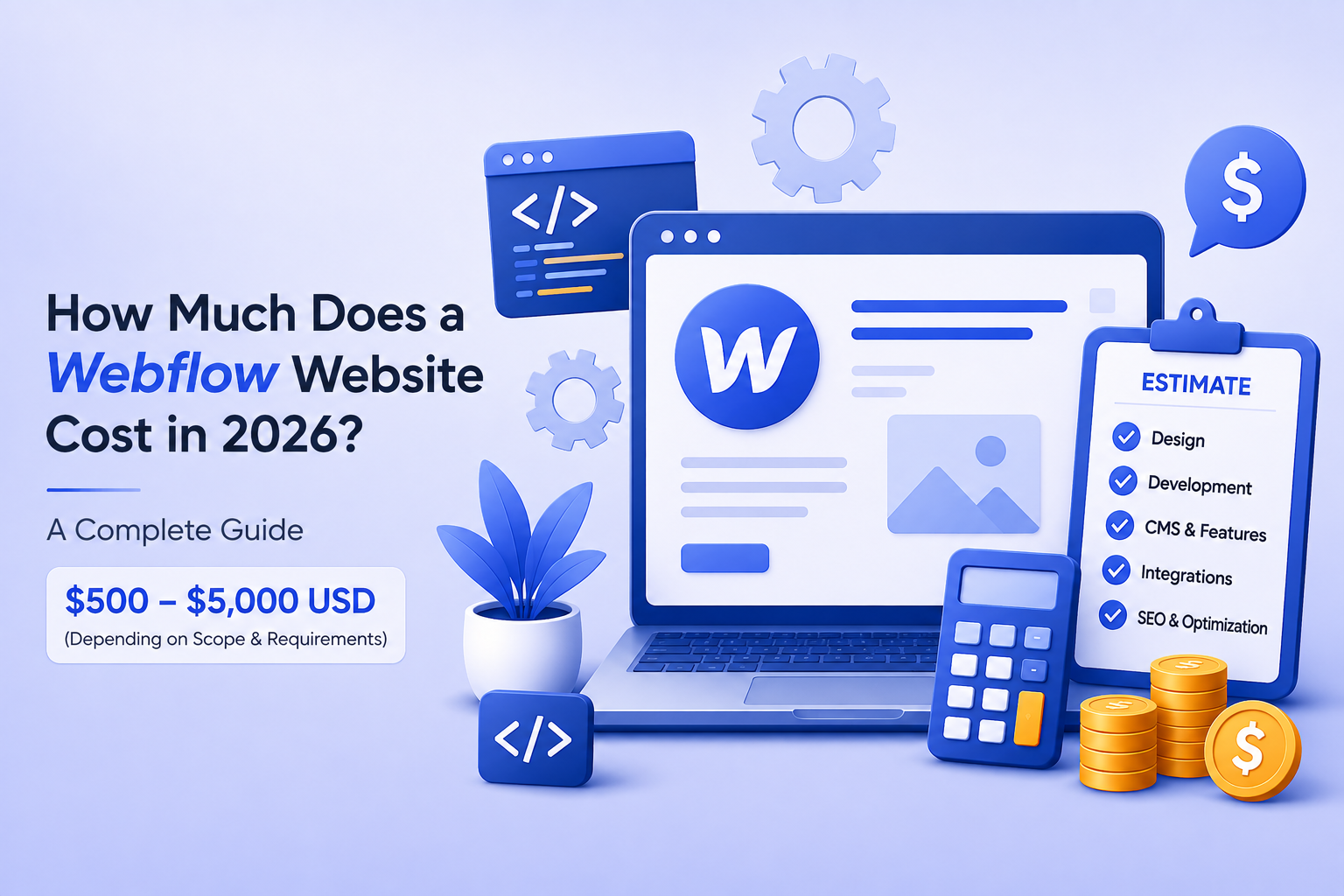
As a general reference, a professionally developed Webflow website may fall within the range of $500–$5,000 USD, depending on the scope and complexity of the project.
This guide explains the factors that can influence Webflow website development costs and what businesses should consider when planning a Webflow project.
Webflow Website Cost: What Should You Expect?
A Webflow website can be relatively simple or highly customized.
A straightforward website with a limited number of pages and standard functionality will generally require less development work than a larger website with custom designs, CMS collections, integrations, animations, and advanced SEO requirements.
For many business websites, the overall Webflow website development investment can typically range from $500–$5,000 USD.
This should be considered a general reference rather than a fixed price.
Every website has different requirements, and the final cost should ideally be determined after reviewing the project’s sitemap, design, functionality, content, integrations, and technical requirements.
What Is Included in a Webflow Website Development Project?
The cost of a Webflow website can include several different services depending on the project’s requirements.
A professional Webflow development project may involve:
- Webflow website design
- UI/UX implementation
- Figma to Webflow development
- Responsive website development
- Webflow CMS setup
- Custom interactions and animations
- Forms and lead-generation functionality
- Third party integrations
- CRM integrations
- SEO implementation
- Technical SEO setup
- Schema markup
- 301 redirects
- Content migration
- Performance optimization
- Mobile and tablet optimization
- Cross-browser testing
- Website quality assurance
- Launch and post-launch support
Not every project requires all of these services, which is one reason Webflow development costs can vary.
What Factors Affect Webflow Website Cost?
1. Number of Pages
The number of pages is one of the factors that can influence development effort.
A small website with a limited number of pages may require less work than a larger website with multiple service pages, landing pages, case studies, resources, and other content.
However, page count alone doesn’t determine the cost.
A well structured website using reusable components and CMS templates can sometimes be developed more efficiently than a smaller website where every page requires a completely different layout.
2. Custom Webflow Website Design
Design requirements can have a significant impact on the overall project.
A website based on an existing design system may require less implementation work, while a completely custom Webflow website may involve more UX planning, responsive design, animations, interactions, and development.
Businesses looking to create a distinctive online presence may benefit from investing in custom Webflow website design rather than relying entirely on pre-built layouts.
3. Webflow CMS Requirements
Webflow CMS can be useful for businesses that regularly publish or manage content.
For example, CMS collections can be used for:
- Blog posts
- Case studies
- Services
- Team members
- Testimonials
- Resources
- Portfolio projects
- Locations
If your website requires a structured CMS, the development process may involve additional planning and configuration.
A Webflow developer needs to consider the content structure, relationships between collections, templates, filtering, search functionality, and how easily your team will be able to manage content after launch.
4. Animations and Interactions
One of Webflow’s strengths is its ability to create visually engaging interactions and animations.
These can range from simple hover effects to more advanced scrolling animations, page transitions, interactive navigation, and other custom experiences.
While thoughtful animation can improve the user experience, complex interactions can require additional development and testing.
The goal should be to use animation where it supports the brand and user experience rather than adding unnecessary complexity.
5. Third-Party Integrations
Many modern business websites need to connect with other platforms.
Examples include:
- CRM systems
- Email marketing platforms
- Analytics tools
- Marketing automation
- Scheduling systems
- Payment platforms
- Lead-generation tools
- Customer databases
- Custom APIs
The complexity of these integrations can influence the overall Webflow development cost.
A simple integration may require minimal setup, while a custom API or multi-step workflow may require considerably more technical work.
6. SEO Requirements
A professional Webflow website should be built with SEO in mind from the beginning.
Webflow provides several tools and settings that support technical SEO, but simply building a website in Webflow doesn’t guarantee search engine visibility.
A Webflow SEO implementation may include:
- SEO titles
- Meta descriptions
- Heading structure
- Image alt text
- URL structure
- Canonical URLs
- XML sitemap configuration
- Robots directives
- Schema markup
- 301 redirects
- Internal linking
- Open Graph settings
- Performance optimization
Businesses that already have organic search traffic should pay particular attention to SEO during a redesign or migration.
How Much Does a Webflow Website Redesign Cost?
If you already have a website, you may not need to start from scratch.
A Webflow website redesign can focus on improving the existing website’s design, user experience, responsiveness, content structure, and conversion performance.
Depending on the scope, a Webflow redesign can generally fall within the broader $500–$5,000 USD range.
The actual investment may depend on whether you’re updating:
- The homepage
- Selected landing pages
- The complete website
- Navigation
- CMS structure
- Responsive layouts
- Website content
- Visual design
- User experience
- SEO structure
A website redesign can be a practical option for businesses that already have valuable content and search visibility but want a more modern and effective website.
How Much Does a Webflow Migration Cost?
Businesses sometimes move their existing websites from platforms such as:
- WordPress
- Wix
- Squarespace
- Shopify
- Custom platforms
- Other website builders
A WordPress to Webflow migration or migration from another platform involves more than copying website content.
A well planned migration may include:
- Page migration
- CMS migration
- Content migration
- Image migration
- URL mapping
- 301 redirects
- Metadata migration
- Internal link updates
- Responsive development
- SEO preservation
- Form migration
- Integration setup
- Testing and quality assurance
Depending on the size and requirements of the existing website, a Webflow migration can fall within the $500–$5,000 USD range for many projects.
Larger or particularly complex websites may require a more detailed assessment before a reliable estimate can be provided.
Webflow Website Cost: Freelancer vs Agency
Another factor businesses often consider is whether to work with an independent Webflow developer or a Webflow development agency.
Both options can be suitable depending on the project.
A freelancer may be a practical choice for smaller websites, landing pages, updates, and projects with a clearly defined scope.
A Webflow development agency may be better suited for businesses that need a broader combination of services, such as:
- Website strategy
- UX/UI design
- Webflow development
- CMS development
- Integrations
- SEO
- Migration
- QA
- Ongoing support
Rather than choosing a provider based only on the lowest quote, businesses should consider the developer’s experience, portfolio, technical approach, communication, and ability to support the website after launch.
Is Webflow Worth the Investment in 2026?
For many businesses, Webflow can be a practical platform for building a modern business website.
It provides a visual development environment while supporting responsive layouts, CMS functionality, interactions, SEO controls, integrations, and website management.
Webflow can be particularly useful for businesses that want greater design flexibility without managing the extensive plugin ecosystem often associated with traditional WordPress websites.
However, Webflow isn’t necessarily the right choice for every project.
The best platform depends on your business goals, technical requirements, content structure, integrations, ecommerce needs, budget, and long-term plans.
A good Webflow development partner should help you determine whether Webflow is actually suitable for your project rather than recommending it automatically.
What Should You Ask a Webflow Developer Before Hiring Them?
Before hiring a Webflow developer or Webflow development agency, consider asking:
- Can you show examples of similar Webflow websites?
- Will the website be fully responsive?
- How will the Webflow CMS be structured?
- Will you implement technical SEO?
- Can you migrate my existing website?
- How will you handle redirects during migration?
- Can you integrate our CRM and marketing tools?
- Will our team be able to update the website easily?
- How will the website be tested before launch?
- Do you provide ongoing Webflow maintenance and support?
These questions can help you evaluate potential partners based on quality and suitability rather than price alone.
Webflow Website Cost: Final Thoughts
So, how much does a Webflow website cost in 2026?
For many businesses, a professional Webflow website project may fall somewhere between $500–$5,000 USD, depending on the project’s requirements and level of customization.
The final investment can be influenced by the number of pages, custom design, CMS functionality, integrations, animations, SEO requirements, migration needs, content, and responsive development.
Instead of focusing only on the initial cost, consider what the website needs to accomplish for your business.
A well developed Webflow website should provide a strong user experience, work effectively across devices, support your SEO strategy, be easy to manage, and provide a solid foundation for future growth.
Looking for a Webflow Development Partner?
At BinaryGrace, we provide Webflow website design and development services for businesses looking to create, improve, or migrate their websites.
Our Webflow services can include custom Webflow website development, Figma-to-Webflow implementation, responsive development, Webflow CMS development, website redesign, WordPress-to-Webflow migration, third-party integrations, technical SEO, performance optimization, and ongoing website support.
Whether you’re planning a new business website or considering moving an existing website to Webflow, we can help you evaluate the requirements and choose an approach that fits your goals.
Get in touch with BinaryGrace to discuss your Webflow website project.